Followers

Sunday, August 14, 2022

Peacepipe - Peacepipe (Outstanding Heavy Psychedelia US 1970)


Size: 94.4 MB
Bit Rate: 256
mp3
Ripped by: ChrisGoesRock
Artwork Included

Peacepipe were the brainchild of guitarist John Uzonyi. They were a power trio that played Southern California and Arizona in the late '60s. They released a single during their existence, and also cut this album, which remained unreleased until the mid-'90s. 

Originally released on Rockadelic on vinyl only, Shadoks has now reissued it on compact disc, remastered from the original tapes. If you're into heavy psych guitar, you really need to hear this album.


Uzonyi has a monstrous tone on guitar, similar at times to Jimi Hendrix's feedback dive-bombing, but the two have very different playing styles.

Uzonyi is aided by drummer Gary Tsuruda and keyboard player Rick Abts, but the show belongs to Uzonyi. There are at least two guitars present most of the time, Uzonyi is the singer, and he most likely plays the bass tracks as well.

Uzonyi formed the band with Tsuruda in the mid-sixties whilst they were still at High School. In 1968 they headed for Hollywood and recorded two tracks; The Sun Won't Shine Forever and Lazy River Blues, which were released on a 45 by Accent. After school Uzonyi joined the U.S. Air Force and was based in Tucson, Arizona. 

There he met Rick Abts who joined Jon and Gary to form The Human Equation. They gigged around the U.S. West but disbanded in 1969 to pursue non-musical careers. Shortly after, though, they reformed to record the tunes, which 26 years later found their way onto a Rockadelic's Peacepipe album. (Jon shelved the project at the time).

Long awaited official reissue of this blistering late '60's US acid rock mind blower. Originally reissued on Rockadelic a few years back (one of the label's best known and rarest releases) here it is in digital glory with cool photos, detailed liner notes and bonus tracks. 

Stunning tripped out guitar based psych with ripping acid wah-wah lead guitars, distortion, swirling keyboards and stoned lyrics. Turn it up to 13 and trip out. Fantastic!

Line-up/Musicians
- John Uzonyi / Guitar, vocals
- Gary Tsuruda / Drums
- Rick Abts / Keyboards

01. Sea Of Nightmares (6:26) 
02. Angel Of Love (4:10) 
03. I Can Never Take Your Dreams Away (6:24) 
04. Carry On Together (2:43) 
05. Bikers Tune (2:49) 
06. Open Your Mind (4:50) 
07. Day The War Has Ended (10:08) 
08. Love Shines (3:12) 
09. Keep A Smilin' Cari (2:49) 
10. Sun Won't Shine Forever (2:49) 
11. Lazy River Blues (3:39)

1. Pipe
or
2. pipe
or
3. pipe

Friday, August 05, 2022

The 50 most valuable records of all time (So Far...)

Hello all music collectors. Summer is here and the rain is pouring down...

I am posting here below the most sought after records as they have sold for up to today from the website: "POPSIKE" Auction prices are from eBay.com.

Good to know: These auction prices do NOT tell you what the disc is worth, the price is more to know how rare it is (in different conditions) and how many people bid on the auction.

The value of an album: It's a pity for anyone who wants to start collecting original albums on vinyl today. Sellers at record fairs and websites ruin it for record collectors. 

I see many sellers who have an LP album that is EX-/M-, but still write the amount that is for records in the MINT GRADE. It is very rare for a record, single, EP and LP album to be in mint condition. A Mint album must be in an absolutely new condition. Both the vinyl and the cover must be in absolutely new condition. For example, if the album looks "Used", it falls to EX+ inexorably and thus the value of the album drops.

The discs in the list below are in different conditions and, as I said, do not tell what the disc is worth. It is enough for the buyers to know that the record is almost impossible to find. The person with the most money wins. 

//ChrisGoesRock


Tuesday, July 26, 2022

The Next Morning - Selftitled (Raw US Heavy 1971)


Size: 64.3 MB
Bitrate: 256
mp3
Ripped By: ChrisGoesRock
Artwork Included

A wickedly rare phase 'n' fuzz fueled slice of psychedelia circa 1970! - featuring ripsnorting guitar-work by Bert Bailey- these guys were Caribbean immigrants (four from Trindad, one from the Virgin Islands) and they idolized the Who and Jimi Hendrix.

African-American psychedelic groups, and rock bands from Trinidad, were both uncommon items around 1970. The Next Morning fit into both categories, making them an interesting curiosity regardless of their music. The music, however--average 1970 hard-rock with soul, hard rock, and psychedelic influences, particularly from Jimi Hendrix--is not as unusual as their origins. One would not suspect from listening that the group were largely from Trinidad, with the proliferation of heavy, bluesy guitar and organ riffs, and the strained soul-rock vocals of Lou Phillips. They recorded one album, released in 1971, that received little notice before their breakup. 


The Next Morning formed in the late 1960s in New York, four of the five members having come to the city from Trinidad; Lou Phillips was from the Virgin Islands. Jimi Hendrix was a big influence on the band, as were some other hard rock acts of the period like the Who, and rock-soul hybrids like Sly Stone and the Chamber Brothers. The Next Morning were busy on the New York club circuit and attracted attention from Columbia Records, but ended up signing to the smaller Roulette label, whose Calla subsidiary issued their lone, self-titled LP in 1971. Although the jagged guitar sounds of Bert Bailey and some unexpected chord shifts made the album less pedestrian than some efforts in the style, the songs tended toward the long and meandering side, and the material was not as outstanding as their influences. The Next Morning's career sputtered out in the early 1970s, with bassist Scipio Sargeant finding some work doing horn arrangements for Joe Tex and Harry Belafonte. The Next Morning album was reissued on CD by Sundazed in 1999. 

01. The Next Morning 4:57
02. Life 2:57
03. Changes Of The Mind 6:01
04. Life Is Love 5:34
05. Back To The Stone Age 5:26
06. Adelane 2:51
07. A Jam Of Love 4:24
08. Faces Are Smiling 6:29 

1. Next
or
2. Next
or
3. Next


Wednesday, July 13, 2022

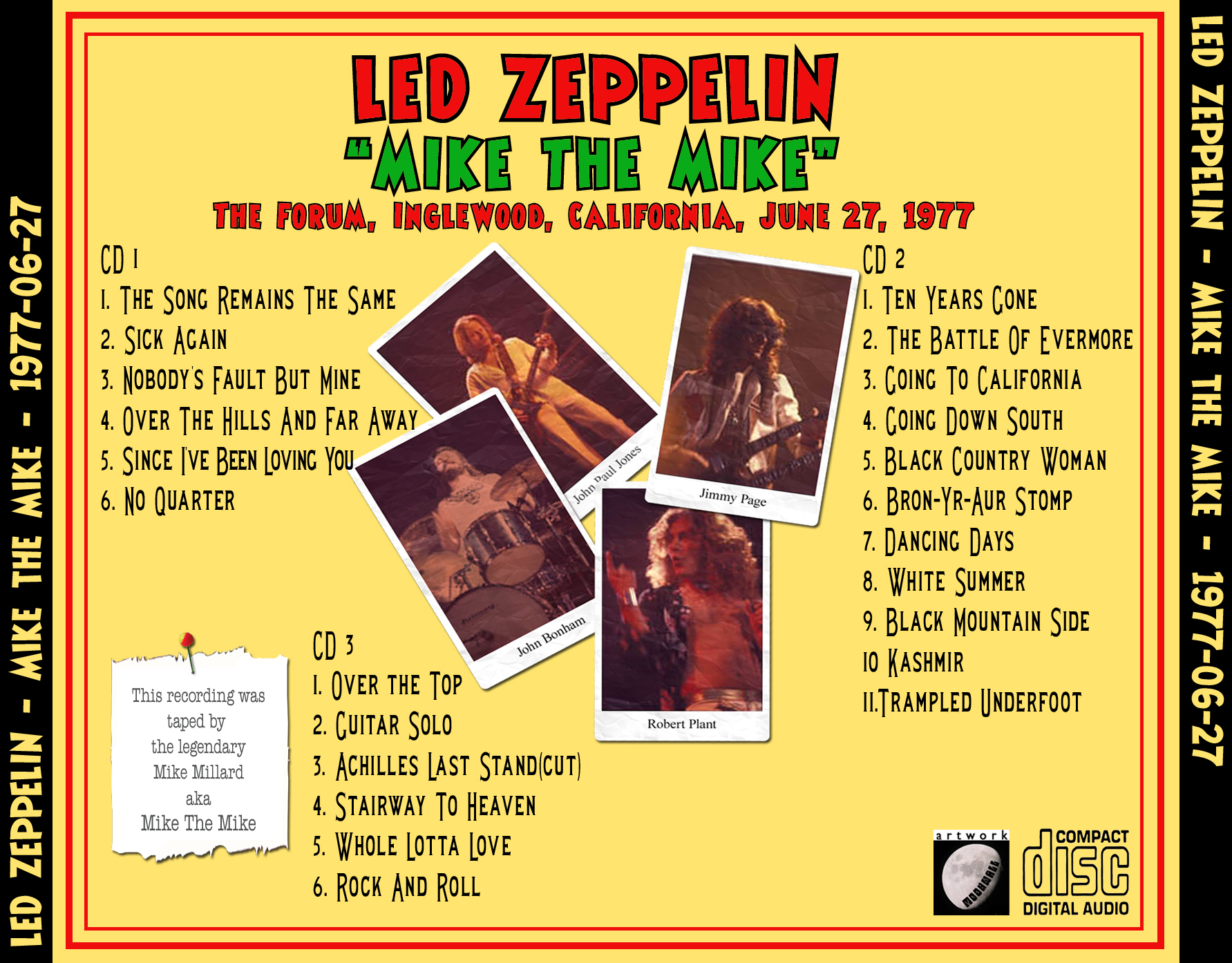
Led Zeppelin - 1977-06-27 Mike the Mike Inglewood US 1977 (3CD) (Bootleg)


Size: 509 MB
Bit Rate: 320
mp3
Recorded by: Mike Millard
Artwork Included

Mike Millard (May 18, 1951 – November 29, 1994), nicknamed "Mike The Mic" was an avid concert taper circa 1973 to 1994, recording over 300 concerts, including Led Zeppelin, Pink Floyd and The Rolling Stones concerts in California. He taped virtually every show at the Forum from 1974 to 1980. Many of his recordings found their way into the hands of bootleggers who sold Millard's work to fans.

Starting with a basic mono recorder in 1973, Millard upgraded to a Nakamichi 550 stereo recorder with AKG Acoustics 451E microphones for the 1975 Led Zeppelin shows in the area. He often used a wheelchair to conceal his equipment, pretending to be disabled. Unlike most 1970s audience bootlegs, Millard's recordings are known for their good sound quality, and are to this day considered some of the finest audio bootlegs available.


Millard's recording of the Led Zeppelin concert on June 21, 1977 at the Forum (allegedly taped from row number six) was released under the title Listen To This Eddie, and remains one of the best-known Led Zeppelin bootlegs. His recording of the opening number from the concert, "The Song Remains The Same", was included in the promos menu of the Led Zeppelin DVD. Millard recorded four of the Rolling Stones five 1975 shows at the LA Forum, and his recording of the Sunday, July 13, 1975 show (titled 'LA Friday') has become one of the most widely spread recordings of a Rolling Stones concert.


Millard was never behind the sale of bootlegs and was openly against the illegal sale of his recordings. He was notorious for "marking" copies of his tapes so that if one of his recordings turned up for sale on LP or CD, he would be able to tell which person he had traded it to. He kept a very detailed logbook of his marked recordings and who they were distributed to. "Unmarked" copies of Millard's recordings are very scarce. In 2016 several unmarked first generation copies of his Led Zeppelin recordings surfaced in trading circles.

Millard is said to have suffered from severe depression. He committed suicide in 1994.

The Millard recording set-up was used by The National in 2019 to record two of their shows in Berkeley, CA, and an accompanying documentary titled Juicy Sonic Magic: The Mike Millard Method was also created.


Mike is most known for the 10 Led Zeppelin shows that he recorded in southern California in the 1970s. Those shows include March 11th and 12th in Long Beach and at the Forum on March 24th, 25th, and 27th on the North American tour. When the band returned to southern California for the concert tour of North America, he recorded the band in San Diego June 19th and then four times at the Forum on June 21st, 23rd, 25th, and 27th.

A 2021 Rolling Stone article  lauded the quality of his April 26, 1975 recording of Pink Floyd, going so far as to say, "If Pink Floyd ever decides to create a Bootleg Series, they should get their hands on Millard’s master tapes — starting with this 1975 Los Angeles gig. It’s the band at the peak of their abilities as a live act and deserves to be heard as widely as possible."

Juicy Sonic Magic: The Mike Millard Method, a 10-minute mini-documentary directed by David DuBois.


The film tells the story of late, great concert taper Mike “The Mike” Millard and an homage to his work that was undertaken by archivist and producer Erik Flannigan, who attempted to recreate the legendary taper’s methods by using the same vintage cassette deck and microphones Millard employed in the ’70s to record our two Greek Theatre concerts last year.

Millard became a legend for his high-quality bootleg recordings of artists like Led Zeppelin, Pink Floyd, Bob Dylan and many others made in and around Southern California in the ’70s and ’80’s by sneaking his equipment into concerts hidden in a wheelchair. The film features animation by illustrator Jess Rotter and Eben McCue, plus interviews with Matt Berninger, producer/archivist Erik Flannigan and Mike Millard’s friend Jim Reinstein, who pushed Millard and his wheelchair into dozens of shows.

Flannigan explained the idea behind using The Mike Millard Method in the liner notes of the accompanying Black Friday Record Store Day three-cassette box set release (out November 29 via 4AD) entitled 'The National: Juicy Sonic Magic, Live in Berkeley, September 24-25, 2018', saying:

“The most celebrated audience taper of the period, Mike Millard, recorded in and around Southern California beginning in 1974 and continued into the early ’90s. Millard’s legend is built in part on the cunning and subterfuge he used to get his nearly 15-pound cassette deck and microphones into venues like the The Forum, Santa Monica Civic Auditorium, and The Roxy. 

For years I have pondered what made Millard’s recordings so good, and eventually I had an idea: What if you recorded a concert today with the same equipment Millard used in 1977? Would it sound like his tapes? Would it tap into his Midas touch?

The National was kind enough to let us test the Millard Method for two concerts at the Greek Theatre in Berkeley, California last September. These live recordings were made with vintage AKG 451E microphones and a restored Nakamichi 550 cassette deck which are identical to those used by Millard circa 1975-81. The idea was to see if we could recreate what Matt Berninger calls the “juicy sonic magic” Millard captured in his 1970s field recordings.

Together with my friend and filmmaker David DuBois, we also produced a short documentary about Millard, his recording methods, and our attempt to recreate his work at the National shows in Berkeley, a venue that is utterly unchanged since the ’70s. 

With the advent of smartphones, thousands of people routinely record part of the show when they attend a National concert or any other performance. Forty years ago, when nobody would dare do that, one man made it his life’s work to preserve legendary concerts on tape.”

Led Zeppelin
The Forum, Inglewood, California
June 27, 1977
Taper: Mike Millard
Title: "Mike the Mike"
 
CD 1
01. The Song Remains The Same  
02. Sick Again
03. Nobody's Fault But Mine  
04. Over The Hills And Far Away
05. Since I've Been Loving You  
06. No Quarter  

CD 2
01. Ten Years Gone
02. The Battle Of Evermore  
03. Going To California
04. Going Down South
05. Black Country Woman  
06. Bron-Yr-Aur Stomp 
07. Dancing Days 
08. White Summer
09. Black Mountain Side  
10 Kashmir
11.Trampled Underfoot 

CD 3
01. Over the Top  
02. Guitar Solo
03. Achilles Last Stand(cut)
04. Stairway To Heaven  
05. Whole Lotta Love
06. Rock And Roll 

Part 1: Mike The Mike
Part 2: Mike The Mike
Part 3: Mike The Mike
or
Part 1: Mike The Mike
Part 2: Mike The Mike
Part 3: Mike The Mike
or
Part 1: Mike The Mike
Part 2: Mike The Mike
Part 3: Mike The Mike

Wednesday, June 22, 2022

Thunderduk - Selftitled (Good Hardrock US 1974)


Size: 71.3 MB
Bit rate: 256
mp3
Ripped By: ChrisGoesRock
Artwork Included

A highly uncommercial Cleveland, Ohio rock group. Their recordings are rather hit and miss affairs. All nine cuts on the Rockadelic album are originals. The finer moments include the driving guitar on opener Why Don't You Love Me?, the fine jamming guitar work on Time And Again and, by contrast, the mellow slow-paced Something To Look At with its dominant percussion work. 

The recordings on the Rockadelic album span the 1972 - 74 period when their desire to play original music and their on stage antics made them one of the top draws on the Cleveland Club scene. Bob Turchek was later replaced on drums by ex-Catscradle drummer Rick Fischer. Most of the material on the Rockadelic album was played by the band on two Agency Studio live broadcasts carried by local station WNCR.


Band photos and raw opening track may tempt one to file this among the typical Rockadelic teenage basement hardrock blowouts, but in actuality this is a local prog/jazzrock affair that's a bit left field both for the label and my hi-fi. The uptempo, energetic excursions suffer from so-so songwriting and a dry, clinical soundscape that cries out for keyboards, fuzz and feedback, and jars with the distorted vocals. Liner notes claim they were a big draw live but it doesn't really sound like it, and there's an odd atonal and out of synch feel to the recording as a whole -- but maybe that's right for the genre. Couple of OK tracks, but too little guitar, and neither psych, folk nor hardrock; may appeal to fans of the UK hard prog scene. 1972-1974 recordings.

01 - Why Don´t You Love Me
02 - Mountain By The Moon
03 - Something to Look At
04 - Time And Again
05 - The Collector
06 - Keep On Comin´
07 - Number One
08 - Once Again Darkness
09 - Jake 26 

or
or

Howling Black Soul - Selftitled (Old School Hardrock UK 2014) Sounds like a band from the early 70's


Size: 81.6 MB
Bit rate: 320
mp3
Ripped by: ChrisGoesRock
Some Artwork Included

"Howling Black Soul are a powerhouse trio like they used to do. Free meets Black Sabbath with a 1972 valve amp thrown in for good measure.....turn this up loud." The band - described as "Free meets Black Sabbath with a 1972 valve amp thrown in for good measure" - have a sound steeped in blues with a retro groove of the late 1960s and early 1970s.


Support will come from teen brothers Ben and Toby Jordan who go by the name Bavard, described as "the youngest song-slingers in town" by their hosts, Howling Black Soul.

Bavard will be playing an electric set, helped by 13-year-old Herbie Buckley-Robinson on full drum kit. On this weeks show I was joined by Essex band `Howling Black Soul` the 3 peice, consisting of Dario on vocals and lead guitar, Simon W on Bass, and Simon C on Drums.


We established that the their music genre was  `Blues Rock`.  this is the band description in their own words;

“Howling Black Soul” Initially sprang from a shared obsession for bands such as `Led Zepplin, `Free`,`Cream, `Jimi Hendrix, and other late 6o`s/early 70`s dirt and the dark art of blues specialists!! Their sound is steeped in blues; however, they have developed a modern spin on the classic genre and build on contemporary influences such as; kasabian`White Strpes`, `The Black keys` ect to create a unique Rock experience…………..

01. Soul to lay 03:24
02. Full of Desire 03:54
03. Myself 03:16
04. Darlin' You 04:45
05. See the Light 03:13
06. Shoot You Down 04:02
07. Brand New Soul 03:26
08. Another Dawn 02:52
09. Roll Out Your Head 04:19

or
or


Thursday, June 02, 2022

Grateful Dead - Selftitled (1st Classic Album US 1967 and a Lot of Bonus Tracks)


Size: 366 MB
Bitrate: 320
mp3
Ripped by: ChrisGoesRock
Artwork Included
Source: Japan SHM-CD Remaster

The Grateful Dead is the debut album of the Grateful Dead. It was recorded by Warner Bros. Records, and was released in March 1967. According to bassist Phil Lesh in his autobiography Searching for the Sound: My Life with the Grateful Dead, the album was released as San Francisco's Grateful Dead.


The album was recorded primarily at Studio A in Los Angeles in only four days. The band had wanted to record the album in their hometown of San Francisco, but no good recording studios existed in the area at the time. The group picked David Hassinger to produce because he had worked as an engineer on the Rolling Stones' "(I Can't Get No) Satisfaction" and Jefferson Airplane's Surrealistic Pillow album (on the latter of which Jerry Garcia had guested as well having suggested the album's title). Demands by Warner Bros. resulted in four of the tracks, originally longer, being cut short. Phil Lesh comments in his autobiography that "to my ear, the only track that sounds at all like we did at the time is Viola Lee Blues. ... None of us had any experience with performing for recording ... although the whole process felt a bit rushed."

The album was seen as "a big deal in San Francisco." Even though this was true, it did not see much air play on AM radio stations outside San Francisco. It would be a couple of months before free-form FM radio stations began to take shape.[4] Warner Bros. threw the band a release party at the Fugazi Hall in North Beach. Joe Smith is noted for saying he is "proud that Warner Bros. is introducing the Grateful Dead to the world."

A remastered version with the full versions of five album tracks, plus six bonus tracks, was released by Rhino in as part of the box set The Golden Road (1965-1973) in 2001, and as a separate album in 2003.
The song "Alice D. Millionaire" was inspired by an autumn 1966 newspaper headline "LSD Millionaire", about the Dead's benefactor and sound engineer Owsley Stanley.

In the original design for the album cover, the cryptic writing at the top read, "In the land of the dark, the ship of the sun is driven by the Grateful Dead", with the phrase "Grateful Dead" in large letters. At the band's request, the writing, except for "Grateful Dead", was changed by artist Stanley Mouse to be unreadable. According to fan legend, the saying is from Egyptian Book of the Dead.


The band used the collected pseudonym McGannahan Skjellyfetti for their group-written originals and arrangements. The name derived from a corruption of a character name in the Kenneth Patchen work The Memoirs of a Shy Pornographer.

The entire LP was remixed in the early 1970s by the Grateful Dead themselves—the original mix is found on LPs bearing the Gold (1967 stereo/mono) Warner Brothers label or W7/WB dark green Warner Brothers label (1968-1971). The remix (palm trees Burbank label) differs significantly from the original 1967 release.


The album was reissued for Record Store Day 2011 on 180g vinyl cut from the original analog/mono masters from 1967. This is the first time in 40+ years it has been released in this form.

The 2013 high definition digital remastered release features the edited versions, as released in 1967, of the four tracks which were extended in the 2003 Rhino release.

Open Picture in a new window

The Grateful Dead's eponymously titled debut long-player was issued in mid-March of 1967. This gave rise to one immediate impediment -- the difficulty in attempting to encapsulate/recreate the Dead's often improvised musical magic onto a single LP. Unfortunately, the sterile environs of the recording studio disregards the subtle and often not-so-subtle ebbs and zeniths that are so evident within a live experience. So, while this studio recording ultimately fails in accurately exhibiting The Grateful Dead's tremendous range, it's a valiant attempt to corral the group's hydra-headed psychedelic jug-band music on vinyl. Under the technical direction of Dave Hassinger -- who had produced the Rolling Stones as well as the Jefferson Airplane -- the Dead recorded the album in Los Angeles during a Ritalin-fuelled "long weekend" in early 1967. 

Rather than prepare all new material for the recording sessions, a vast majority of the disc is comprised of titles that the band had worked into their concurrent performance repertoire. This accounts for the unusually high ratio (seven:two) of folk and blues standards to original compositions. The entire group took credit for the slightly saccharine "Golden Road (To Unlimited Devotion)," while Jerry Garcia (guitar/vocals) is credited for the noir garage-flavored raver "Cream Puff War." Interestingly, both tracks were featured as the respective A- and B-sides of the only 45 rpm single derived from this album. The curious aggregate of cover tunes featured on the Dead's initial outing also demonstrates the band's wide-ranging musical roots and influences. 

These include Pigpen's greasy harp-fuelled take on Sonny Boy Williamson's "Good Morning Little School Girl" and the minstrel one-man-band folk of Jessie "the Lone Cat" Fuller's "Beat It On Down the Line." The apocalyptic Cold War folk anthem "Morning Dew" (aka "[Walk Me Out in The] Morning Dew") is likewise given a full-bodied electric workout as is the obscure jug-band stomper "Viola Lee Blues." 

Fittingly, the Dead would continue to play well over half of these tracks in concert for the next 27 years. [Due to the time limitations inherent within the medium, the original release included severely edited performances of "Good Morning Little School Girl," "Sitting on Top of the World," "Cream Puff War," "Morning Dew," and "New, New Minglewood Blues." These tracks were restored in 2001, when the Dead's Warner Brothers catalog was reassessed for the Golden Road (1965-1973) box set.] [Wikipedia + AMG]
 
Personnel
♫♪♪♫♪ Jerry Garcia – lead guitar, vocals, arrangement
♫♪♪♫♪ Bill Kreutzmann – drums
♫♪♪♫♪ Phil Lesh – bass guitar, vocals
♫♪♪♫♪ Ron "Pigpen" McKernan – keyboards, harmonica, vocals
♫♪♪♫♪ Bob Weir – guitar, vocals

01. "The Golden Road (To Unlimited Devotion)" (Grateful Dead) – 02:12
02. "Beat It on Down the Line" (Jesse Fuller) – 2:33
03. "Good Morning Little School Girl" (Sonny Boy Williamson) – 05:50
04. "Cold Rain and Snow" (Obray Ramsey) – 02:31
05. "Sitting on Top of the World" (Lonnie Chatmon and Walter Vinson) – 02:08
06. "Cream Puff War" (Jerry Garcia) – 02:31
07. "Morning Dew" (Bonnie Dobson and Tim Rose) – 05:09
08. "New, New Minglewood Blues" (Noah Lewis) – 02:37
09. "Viola Lee Blues" (Lewis) – 10:17

Bonus tracks: Live July 29, 1966
10. Standing on the Corner (Live at P.N.E. Garden Auditorium)  03:22
11. I Know You Rider (Live at P.N.E. Garden Auditorium)  03:14
12. Next Time You See Me (Live at P.N.E. Garden Auditorium)  03:36
13. Sittin' on Top of the World (Live at P.N.E. Garden Auditorium) 03:46
14. You Don't Have to Ask (Live at P.N.E. Garden Auditorium)  05:14
15. Big Boss Man (Live at P.N.E. Garden Auditorium)  04:15
16. Stealin' (Live at P.N.E. Garden Auditorium)  03.37
17. Cardboard Cowboy (Live at P.N.E. Garden Auditorium)  02:56
18. It's All over Now, Baby Blue (Live at P.N.E. Garden Auditorium)  05:22
19. Cream Puff War (Live at P.N.E. Garden Auditorium)  07:52
20. Viola Lee Blues (Live at P.N.E. Garden Auditorium) 10:02
21. Beat It on down the Line (Live at P.N.E. Garden Auditorium)  02:46
22. Good Mornin' Little Schoolgirl (Live at P.N.E. Garden Auditorium)  05:47

July 30, 1966
23. Cold Rain and Snow (Live at P.N.E. Garden Auditorium)  03:14
24. One Kind Favor (Live at P.N.E. Garden Auditorium)  04:23
25. Hey Little One (Live at P.N.E. Garden Auditorium)  05:39
26. New, New Minglewood Blues (Live at P.N.E. Garden Auditorium)  03:22

Extra Bonus
27. "Alice D. Millionaire" (Grateful Dead) – 2:22
28. "Overseas Stomp (The Lindy)" (Jab Jones and Will Shade) – 2:24
29. "Tastebud" (Ron McKernan) – 4:18
30. "Death Don't Have No Mercy" (Reverend Gary Davis) – 5:20
31. "Viola Lee Blues" (edited version) (Lewis) – 3:00
32. "Viola Lee Blues" (live at Dance Hall, Rio Nido, CA 9/3/67) (Lewis) – 23:13

• The Japan CD reissue contains the full-length versions of "Good Morning Little Schoolgirl", "Sitting on Top of the World", "Cream Puff War", "Morning Dew", and "New, New Minglewood Blues"

• Tracks 27-30 recorded at RCA Victor Studio A, Hollywood, CA on February 2, 1967
• Track 31 is an edited version of track 09.
• Track 32 recorded live at Dance Hall, Rio Nido, CA on September 3, 1967; the master analog reels of "Viola Lee Blues" are said to exclude the beginning of the song.

Part 1: Grateful
Part 2: Grateful
or
Part 1: Grateful
Part 2: Grateful
or
Part 1: Grateful
Part 2: Grateful


Thursday, May 12, 2022

Sly & The Family Stone - The Woodstock Experience (US 1969)


Size: 102 MB
Bit-rate: 256
mp3
Ripped by: ChrisGoesRock
Artwork Included
Source: Japan 24-Bit Remaster

In late 1968, Sly and the Family Stone released the single "Everyday People", which became the band's first number-one hit. "Everyday People" was a protest against prejudices of all kinds, and popularized the catchphrase "different strokes for different folks." With its b-side "Sing a Simple Song", it served as the lead single for the band's fourth album, Stand!, which was released on May 3, 1969. The Stand! album eventually sold more than three million copies; its title track peaked at number 22 in the U.S. Stand! is considered one of the artistic high points of the band's career; it contained the above three tracks as well as the songs "I Want to Take You Higher", which also appeared on the b-side of the "Stand!" single, "Don't Call Me Nigger, Whitey", "Sex Machine", and "You Can Make It If You Try".


The success of Stand! secured Sly and the Family Stone a performance slot at the landmark Woodstock Music and Art Festival. The band performed their set during the early-morning hours of August 17, 1969; their performance was said to be one of the best shows of the festival. A new non-album single, "Hot Fun in the Summertime", was released the same month and went to number two on the U.S. pop charts (peaking in October, after the summer of 1969 had already ended). In 1970, following the release of the Woodstock documentary, the single of "Stand!" and "I Want to Take You Higher" was reissued with the latter song now the a-side; it reached the Top 40. 


Sony/BMG's Legacy imprint decided to commemorate the 40th anniversary of Woodstock by issuing a slew of double-disc deluxe packages by catalog artists who played the festival. Each slipcase contains the featured artist's entire performance at Woodstock and, as a bonus, an LP sleeve reproduction of a classic album issued near the time the festival occurred, as well as fine, individually designed 16" X 24" double-sided posters. Sly & the Family Stone were riding the chart success of Stand!, their fifth album in three years(!), that had been released the previous May for Epic when they played the Woodstock Festival. Going on at 3:30 in the morning of Sunday, August 17, 1969, they brought their West Coast meld of soul, R&B, gospel, positive vibes, and the newly emerging funk to the tired masses and turned them into a stomping, screaming, joyous, army of believers. Hearing this set reconstructed in its original context is a gift. 

The band came storming out of the gate with "M'Lady," and didn't stop for 50 minutes. The music that had previously been heard on the Woodstock albums -- "Dance to the Music," as well as the medley of "Music Lover/"Higher," and "I Want to Take You Higher" -- actually took place in the middle of the band's concert. Before and after are six other performances that have never been issued before. The gig was comprised mainly of tracks from the then-current album: the title track, "Everyday People," "Sing a Simple Song," "I Want to Take You Higher," and "You Can Make It If You Try." 

"Love City," a little known jam from the M'Lady LP is also here. "Stand" closes the album on a somewhat mellower groove than they'd started with at its 100-miles-an-hour pace, but it's presented with the ease and flawless execution of a group of master show men and women who can take a crowd to the outer edges of excitement and bring them back seamlessly. The funk groove at the end of the track assures concertgoers that what they'd just heard was real. Sonically, it fares a little better than some of the volumes in this bunch: Eddie Kramer did a fantastic job of mixing. This is a surprise and one of the best titles in the series hands down.

Growing up in a bastion of white Protestant wealth, opportunities to hear really good funk or soul music were severely limited. The radio stations in the 1970s were either awash with disco, pseudo-intellectual rock, or vacuous pop music. Everybody was either listening to that stuff, or just as bad, strutting white boys trying to make as much noise as possible while still calling it music. So it wasn't until one fateful night in a second run movie theatre which showed a battered print of Woodstock on alternating nights with The Rocky Horror Picture Show that I received my first real dose of funk.

Okay reading that back I know it sounds bad, but I can't think of any other way of describing what happened when Sly & The Family Stone invaded the movie screen that night. By the time they show up on screen in the movie you've already been sitting for a couple hours and for any number of reasons you've descended into a bit of a stupor. In those days you didn't even have to bring your own dope to get high at the movies as sooner or later one of the clouds drifting through the theatre would land on you head and you'd be gone. Then all of a sudden the screen explodes in a burst of sound and colour as Sly and company burst onto stage bedecked in a bedazzling array of colours and material.
After a few moments of preening the bass starts churning, horns start blaring, and the guitar and keyboard are pounding out a rhythm that wakes up your blood – and that's only the intro. That first time watching "The Family" was a blur of horns and vocal pyrotechnics as Sly reached out and grabbed those hundreds of thousands of people in the dark beyond the stage by the throat and shook them awake (They went on stage at three in the morning). On the original soundtrack and in the movie all you get is a taste of what they performed that early Sun

day morning, and even just the medley of "Music Lover/Higher" was enough to rouse even the most stoned of us sitting in that run down theatre. Now that I've heard their entire set as part of the Legacy Recordings' release Sly And The Family Stone: The Woodstock Experience, I'm trying to imagine what it must have like for those in the audience at Woodstock to have that thrust in front of their eyes at 3:00 am.

As well as the disc containing the live recording of their set at Woodstock, also included in this package is a reissued version of the studio recording the band had released earlier that year, Stand!. Like all of their music, it contained a mixture of high stepping funk music that would knock your socks off and political messages like the song "Don't Call Me Nigger Whitey". While they didn't play that particular track at the Woodstock festival, the majority of their set was drawn from that album, including their hit "Everyday People", as well as "Stand", "Sing A Simple Song", "You Can Make It If You Try", and "I Want To Take You Higher".


It was that last song that had made such an impression on me during the movie, but now I was just listening to their performance without the visual stimulation, or any other kind for that matter, of seeing the band. So I was a little concerned that the music on the disc wouldn't stand up well in comparison to my memories of that first time watching them on screen. Well I needn't have worried because the live CD is a great experience. The sound quality is wonderful as you're able to hear everything from the great harmonies on "Everyday People" to the power of the horns on "Dance To The Music".
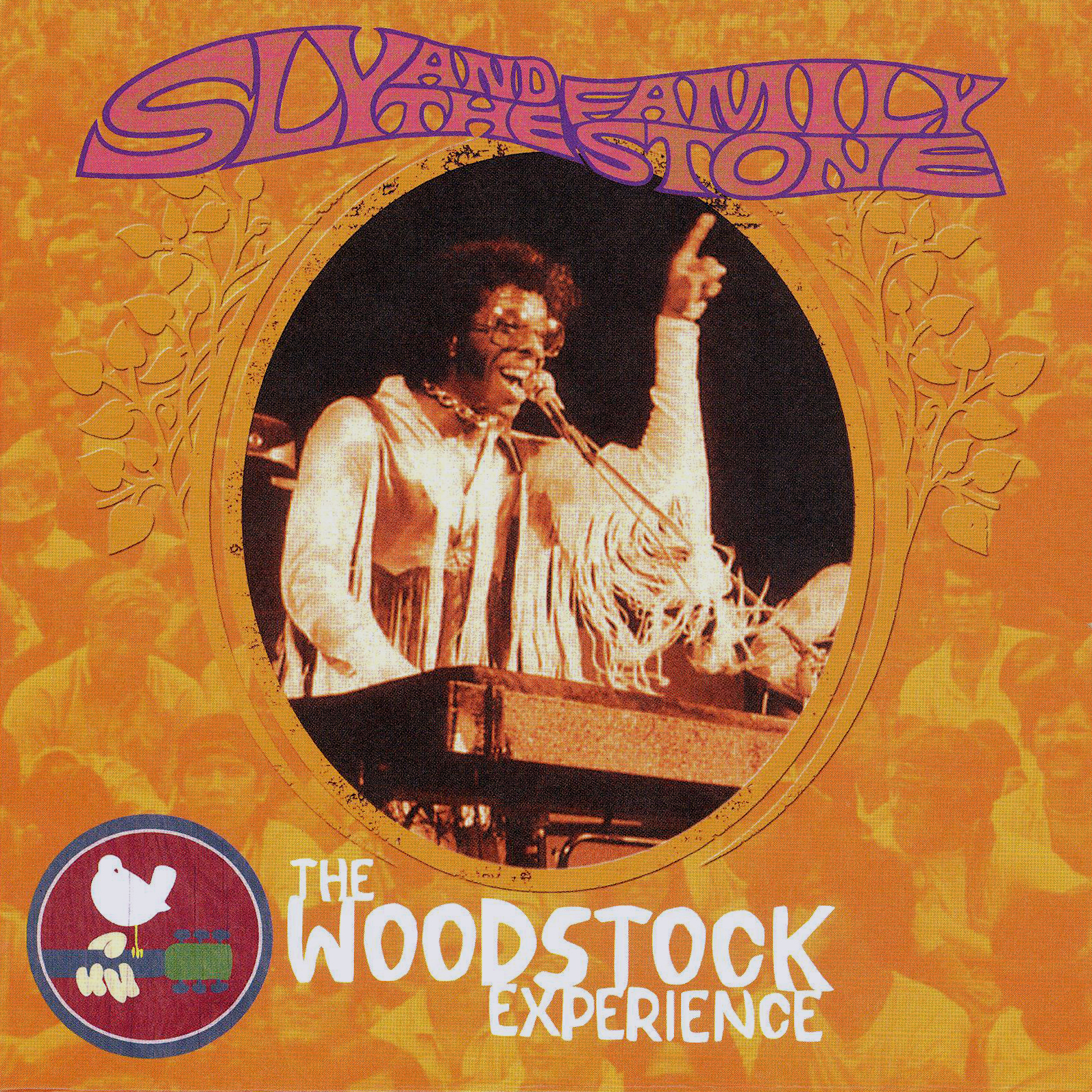
In fact upon comparing the live recording with the studio versions of the same songs I found the latter to be less impressive. Oh sure the sound quality is better in the studio, but this band seems to big for a studio, and it felt like they were held in check. It was like the difference between seeing a horse trotting around in a paddock and watching it gallop full speed across a range towards the horizon. In part that's because of the way Sly And The Family Stone include the audiences in their shows, as you can hear on the call and response sing alongs that they instigate during the "Music Lover/Higher" medley, but mainly it's because when they hit their stride they generate enough energy to power a small city.

It's true that on the studio album one is more aware of the social/political nature of their material because you're able to focus on their lyrics a little easier. On the other hand Sly does make sure to literally spell out part of the band's message during the live show by enticing the audience to spell out a four letter word. As they had participated in the "Fish Cheer" led by Joe McDonald of Country Joe And The Fish earlier in the weekend, you can be forgiven for not guessing that the word he had in mind was Love. However in the church of Sly And The Family Stone, peace, love and harmony were the message.

Aside from the two discs that are part of the Sly And The Family Stone: The Woodstock Experience package, there's also a poster of Sly from the concert included. The photo captures him from the chest up and shows the beginnings of his arms reaching for the sky with the fringes of his jacket spreading like feathers from the sleeves. His mouth is open in what appears to be an ecstatic shout of exultation and all in all he seems to be about to take flight. That picture captures something of the energy you feel from the music performed on the live disc and gives you some small indication of how the band must have looked to their audience that early morning in August.

It's not often that a live recording is able to recreate the energy of a concert. However, in this instance, you really feel like you're carried back forty years to when Sly And The Family Stone took the stage at Woodstock. It's an experience not to be missed. 

Personnel
Sly Stone – vocals, Keyboards
Freddie Stone – guitar, vocals
Larry Graham – bass, vocals
Rose Stone – keyboards, vocals
Cynthia Robinson – trumpet, vocals
Jerry Martini – saxophone
Greg Errico – drums

01. "M'Lady" – 7:46
02. "Sing a Simple Song" – 5:13
03. "You Can Make It If You Try" – 5:36
04. "Everyday People" – 3:15
05. "Dance to the Music" – 4:28
06. "Music Lover" / "Higher" – 7:50
07. "I Want to Take You Higher" – 6:43
08. "Love City" – 6:04
09. "Stand!" – 3:20

1. Sly
or
2. Sly
or
3. Sly