Followers

Thursday, December 26, 2013

Van Der Graaf Generator - The Least We Can Do Is Wave to Each Other (2nd Album UK 1970)


Size: 122 MB
Bitrate: 256
mp3
Ripped by: ChrisGoesRock
Artwork Included
Source: Japan SHM-CD Remaster

The Least We Can Do Is Wave to Each Other is the second album by the British progressive rock band Van der Graaf Generator. It was released in 1970. The album was reissued in re-mastered form, with two bonus tracks, in 2005.

While this is the second album in the Van der Graaf Generator catalogue, it is really the first proper album by the band. Their previous album, The Aerosol Grey Machine had been written and recorded as a solo record by singer and main songwriter Peter Hammill, but because of a deal with the record company, was released under the Van der Graaf Generator name.

The Least We Can Do Is Wave to Each Other was recorded at Trident Studios, London, 11–14 December 1969. Trident was one of the most advanced studios in all of Europe at the time. Most of the album was recorded on an 8-track reel to reel machine. However, the song After The Flood was recorded on a new state of the art 16-track recorder. It was one of the first such 16 track recordings made in the U.K.

The album credited Hugh Banton with writing the cello parts on "Refugees", but he was not given an actual songwriting credit. The first U.S. issue of the album was released by the Probe Records division of ABC Records also in 1970. It featured a different cover than the U.K. version.

The title is taken from artist John Minton: "We're all awash in a sea of blood, and the least we can do is wave to each other."

Peter Hammill has always had an abiding interest, it seems, in the blurred boundary between the mystical and the scientific, and between the rational and magical mind; this is certainly evident on the debut Van Der Graaf Generator album, even though Hammill had yet to really begin focusing himself on what it was that was driving him (despite the fact that the band's very name referenced a device that resembles a bastard mix of scientific apparatus and shamanic totem). 

The Least We Can Do brings those concerns to the fore with ferocity, with time out for a couple of more personal pieces ("Refugees" and "Out of Our Book"). Hammill's lyrics, delivered with all the passion and intent he can muster, reference mysticism, numerology, astrology, various religious pantheons, the Malleus Maleficarum (leading Hammill to conclude, a bit too hopefully, that magic needs to be gray to be balanced), Robert van deGraaf himself (in "Whatever Would Robert Have Said?"), the future of humanity, and surviving ecological catastrophe. 

This being the start of the 1970s, the hopeful notes are drowned out by the tidal wave of fear, sadness, and despair, despite which, the music does tend to be rather uplifting, thanks to the undercurrent of barely restrained majesty VDGG tended to have (possibly thanks to Hugh Banton, who had been rather used to communicating with God via church and cathedral organs; he brought that expertise to a position more normally occupied by determined B3 thumpers engaged in battle with show-horse guitarists). The main thing that The Least We Can Do is in need of now is a good remastering job (and the addition of a few leftover tracks, such as the "Refugees" single version and its B-side.)

Wikipedia Biography:
Van der Graaf Generator are an English progressive rock band, formed in 1967 in Manchester by singer-songwriter Peter Hammill and Chris Judge Smith and the first act signed by Charisma Records. They did not experience much commercial success in the UK, but became popular in Italy during the 1970s. In 2005 the band reformed, and continue to perform as of 2013.

01 FEB 70 England, London, Lyceum
The band formed at Manchester University, but settled in London where they signed with Charisma. They went through a number of incarnations in their early years, including a brief split in 1969. When they reformed, they found minor commercial success with The Least We Can Do Is Wave to Each Other, and after the follow-up album, H to He, Who Am the Only One, stabilised around a line-up of Hammill, organist Hugh Banton, saxophonist David Jackson, and drummer Guy Evans. The quartet subsequently achieved significant success in Italy with the release of Pawn Hearts in 1971.

After several exhausting tours of Italy, the band split in 1972. They reformed in 1975, releasing Godbluff and frequently touring Italy again, before a major line-up change and a slight rename to Van der Graaf. The band split in 1978. After many years apart, the band finally united at a gig at the Royal Festival Hall and a short tour in 2005. Since then, the band has continued as a trio of Hammill, Banton, and Evans, who record and tour regularly in between Hammill's concurrent solo career. Their most recent album, ALT, was released in June 2012.
The group's albums have tended to be both lyrically and musically darker in atmosphere than many of their prog-rock peers (a trait they shared with King Crimson, whose guitarist Robert Fripp guested on two of their albums), and guitar solos were the exception rather than the rule, preferring to use Banton's classically influenced organ, and, until his departure, Jackson's multiple saxophones. While Hammill is the primary songwriter for the band, and its members have contributed to his solo albums, he is keen to stress that the band collectively arranges all its material. 

Hammill's lyrics frequently covered themes of mortality, due to his love of science fiction writers such as Robert Heinlein and Philip K Dick, along with his self-confessed warped and obsessive nature. His voice has been a distinctive component of the band throughout its career. It has been described as "a male Nico" and would later on be cited as an influence by Goth bands in the 1980s. Though the group have generally been commercially unsuccessful outside of early 1970s Italy, they have inspired several musicians, including John Lydon and Julian Cope.

01 JUN 70 England, London, Royal Festival Hall (Charisma Groups)
The band formed in 1967 at Manchester University, after Chris Judge Smith, who had already played in several British rhythm and blues groups whilst a pupil in Oundle School, returned from a trip to San Francisco and, inspired by the bands he had seen, put together a list of possible band names to form a new group. After an unsatisfactory audition they had both attended in response to an advert to form a band, he met fellow student Peter Hammill, who was playing some of his original songs. Hammill had begun writing songs and poetry at the age of 12 while at prep school, and progressed to playing in bands while a pupil at Beaumont College. He was then briefly employed as a computer programmer, during which time he subsequently claimed to have written much of the band's early material, before enrolling at Manchester. Smith was so impressed with the quality of Hammill's original material that the two agreed to form a band together. The band name chosen from Smith's list was based on a Van de Graaff generator, a mechanical device that produces static electricity with impressive lightning-like flashes – the misspellings are accidental. Smith recalls the reason for this may have been that Van de Graaff died in 1967, which was widely reported in the media.

Van Der Graaf Generator - Poster Front
Among the bands that regularly played the university, including Cream, Jimi Hendrix, and Pink Floyd, they were particularly impressed by The Crazy World of Arthur Brown, and recruited an organist, Nick Pearne, to match the format of Arthur Brown's band. Along with two female dancers, the initial line-up was Hammill on guitar and vocals, Smith on drums, wind instruments and vocals, and Pearne on organ, though he did not initially have an instrument. According to Smith, the band initially played as a two-piece, with Smith occasionally using a typewriter as a percussion instrument; their first gig as a three piece was in the student union, which lasted five minutes before the group's amplifiers blew up.

The band managed to persuade fellow student Caleb Bradley to manage them, and by the start of 1968, the band had managed to record a demo tape influenced by blues and jazz, sending it to Lou Reizner, then the U.K. head of Mercury Records, who offered the trio of Hammill, Smith, and Pearne a recording contract in May. At this point, the band had to make a decision whether to stay on at university, or quit their courses and move to London to turn professional. Pearne was not keen to abandon his studies, so decided to leave the group.

Van Der Graaf Generator - Japanese CD Disc
On arrival in London, Hammill and Smith met up with trainee BBC engineer and classically trained organist Hugh Banton, who was a brother of one of their friends back in Manchester. Later that year, they met Tony Stratton-Smith, who agreed to sign a management contract with them in December. Through him, the band acquired a bass guitar player, Keith Ellis, with drummer Guy Evans joining not too long afterwards. This line-up performed on BBC Radio 1's Top Gear radio show in November, and recorded a series of demos for Mercury, before releasing a single ("People You Were Going To" b/w "Firebrand") on Polydor Records in January 1969. Melody Maker said the single was "one of the best records of the week". But the single was quickly withdrawn under pressure from Mercury, since it violated the contract band members Hammill and Smith signed the previous year. Smith, feeling superfluous to requirements, left the band, amicably, shortly after the recording of the single.

Meanwhile, Mercury refused to let the band record, and at the same time Stratton-Smith refused to let the other members of the band sign to Mercury too, as he did not think the deal was fair to the band (only Hammill remained now of the original three who had signed with Mercury). 

US Album Cover
On top of that in late January 1969 the band's van and equipment were stolen. The theft aggravated their financial difficulties. Although the band was touring successfully, which included a concert in February at the Royal Albert Hall in support of Jimi Hendrix,
 it broke up in June after playing a final gig at Nottingham's Pop & Blues Festival on May 10th entirely with borrowed equipment. John Peel, who was compering the show, announced their break-up to the audience.

In July 1969, Hammill had begun performing solo at The Marquee in London, and since there was no group, he decided to record what was intended to be his first solo album at Trident Studios on 31 July and 1 August, with Banton, Evans, and Ellis as session musicians. However, through a deal worked out by Stratton-Smith, the album, The Aerosol Grey Machine, was released by Mercury under the band's name in return for releasing the band from their contract. The album was initially only released in the United States with hardly any promotion at all, so sales were minimal, but the group decided to reform in the middle of the recording session. However, Ellis had already committed to joining Juicy Lucy and was replaced by Evan's former bandmate in The Misunderstood, Nic Potter. 

Vad der Graaf Generator Advertise 1970
The band had also enjoyed flautist Jeff Peach's contributions to the album and wanted to recruit a further instrumentalist. "There was always the idea of having another melodic instrument," recalled Evans. "He [Banton]'ll play a solo, sure, and really give it something, but he doesn't want to do that all the time." Peach was approached to become a full time member, but dropped out after one rehearsal. The position was eventually filled by saxophonist and flautist David Jackson, who had previously played in a band called Heebalob with Smith. Hammill had already sat in with Heebalob at the Plumpton National Jazz Festival on 9 August, and, impressed by Jackson's playing, invited him to join the band, partly because he also needed a flatmate to help pay with the rent.

In September, the new five piece band began rehearsals in Notting Hill Gate. and began to modify its sound. Banton, influenced by the effects pedals popularised by Jimi Hendrix, used his electronic skills to modify a Farfisa organ, giving it a wider variety of sounds. Jackson took his jazz influences, particularly Rahsaan Roland Kirk, and began to play multiple saxophones (usually alto and tenor) simultaneously. Hammill, for his part, elected to sing in received pronunciation, exploring the full range of his vocal capabilities. "We were all megalomaniacs," said Banton. "We grabbed our own space as best we could." The band started to gig regularly, including the first of several live appearances at the Friars Aylesbury in November.

Article About the Band 1968
(open picture in a NEW window for 100% size)
Tony Stratton-Smith formed Charisma Records and signed the band as his first act, who recorded their second album, The Least We Can Do Is Wave to Each Other from 11 - 14 December with John Anthony in Trident Studios. Hammill's voice was electronically treated on After The Flood, while Refugees and White Hammer featured cello and cornet respectively. Because the band finished ahead of their rehearsal schedule, Potter decided to overdub some electric guitar - an instrument he had never played before. The album was released in February 1970 and made the top 50 in the U.K, Melody Maker said "If all our groups were as together as this, the British music scene would improve ten-fold."

Potter, however, did not feel he fitted into this increasingly experimental sound the band was developing, and tended to wait until the others had worked out their parts during rehearsals, adding his bass lines on top at the last minute. After recording three tracks of their third album, H to He, Who Am the Only One, he decided to quit the band. His last gig was on 9 August at the 1970 Plumpton Festival. The remaining members auditioned Dave Anderson, roadie for Brinsley Schwartz and friend of the band, but after a week's rehearsal, found that things weren't working out musically. Banton, meanwhile, had become influenced by Vincent Crane's work in Atomic Rooster, where Crane played the bass lines on a Hammond Organ's bass pedals, and suggested that he could do this as well. 

Promo Picture 1971
With just days to go before the next gig, they tried rehearsing as a four piece, and it was successful. Banton later played bass guitar on certain songs, having already learned the instrument in the mid-1960s, and Hammill expanded his instrumental capabilities on stage to cover piano and keyboards as well as guitar. Jackson modified his saxophones to be completely electric, as opposed to simply being amplified through a microphone, and combined the sound with a wah-wah pedal and an octave divider.

H To He continued to be recorded sporadically throughout 1970, and featured Robert Fripp of King Crimson contributing guitar on "The Emperor in His War-Room". John Anthony knew Fripp socially, and invited him to a session as a guest, something Fripp had never done before at that point. According to Jackson, Fripp "put headphones on and started searing away", listening to the track once, then performing two takes. Killer, later to become a live favourite, recycled a middle 8 from an old Heebalob song, and Smith received a co-composition credit on the track. Reviewing the album, Sounds particularly praised Jackson's saxophone work.

16 APR 70 England, London
Empire Rooms (for Kilburn Poly)
The Hammill/Banton/Jackson/Evans quartet that resulted from H to He, Who Am the Only One is now considered the "classic" line-up, and went on to play as part of the "Six Bob Tour" in early 1971 with fellow Charisma labelmates Genesis and Lindisfarne. Despite the complexity of their music, the band were well received on the tour, with Hammill noting "at nearly all the gigs, most of the audience have known most of the songs ... It was like a big family actually, exactly as all of us had pictured it in our wildest dreams."

While on tour, the band started working out compositions between gigs for their next album, which would become Pawn Hearts. The intention was to release a double album, and the band recorded the material; however, for economic reasons, the released recording was a single album containing three tracks – "Lemmings", "Man-Erg", and the 23 minute concept piece "A Plague of Lighthouse Keepers". Reflecting on this, Hammill said: "Charisma Records felt that it wasn't appropriate for us to release a double album and they vetoed the live studio recordings and the solo tracks by Guy, David, and Hugh.":8 The master tape of the recording sessions has been lost.

Fripp again provided a cameo appearance on guitar. While "Man-Erg" had already been performed on stage, "A Plague of Lighthouse Keepers" evolved in the studio, recorded in small sections and pieced together during mixing.:9 According to producer John Anthony, the track features a lot more studio experimentation than on previous albums, saying "we pushed the facilities at Trident to the limit and had involved the use of every single tape machine in Trident at some stage." :10 The experiments included tape manipulation and Banton playing Mellotron and synthesizer. According to Jackson, one section of it features the entire band overdubbed 16 times.:11 The album was not a success in the U.K, but proved highly successful in Italy, topping the chart there for 12 weeks. The following single, "Theme One", reached number one in Italy, too. "Theme One" was an instrumental piece, originally written by Beatles producer George Martin as a fanfare for the BBC radio station Radio 1, later to appear on US pressings of Pawn Hearts.

28 JUN 70 England, London, Marquee Club (Rock Dates)
Following commercial success in Italy, the band did a six-week tour there at the start of 1972. The band were apprehensive about touring there, concerned they might be playing to half empty venues, but they were all shocked by the sheer volume of the crowds that came to see them. "Pawn Hearts was seen as the ultimate album by the ultimate band," said Jackson, who at times found it difficult to walk down the street in parts of Italy without being recognised. "The tour was like the prophets have landed ... you couldn't go anywhere without this lunatic 'Generator Mania' breaking out." After the tour, the group was immediately offered another Italian tour, this time doing up to three shows a day. In between the tours, the band made an appearance on Belgian television performing "Theme One" and "A Plague of Lighthouse Keepers". Since the studio recording of "A Plague of Lighthouse Keepers" was a collage of multiple recordings, impossible to reproduce live in one setting, the band simply filmed individual sections of the song and spliced them together in the editing suite. It is believed to be the only live performance of the song.

By June, the band had performed another Italian tour (the third that year) and wanted to start recording new material (some of which ended up on Hammill's solo album Chameleon in the Shadow of the Night). However, the combination of working for too long without a break, combined with a lack of support from Stratton-Smith and Charisma and continued financial difficulties caused the band to implode, and Hammill left to pursue a solo career in mid-1972.

The three remaining members recorded an instrumental album with Nic Potter, Ced Curtis, and Pietro Messina, under the name "The Long Hello". Their self-titled album (The Long Hello) was released in 1974.

Personnel:
♦ Peter Hammill – acoustic guitar and lead vocals; piano on "Refugees"
♦ Hugh Banton – Farfisa organ, piano and backing vocals
♦ Nic Potter – bass guitar and electric guitar
♦ Guy Evans – drums and percussion
♦ David Jackson – tenor and alto sax, flute and backing vocals

Additional musicians:
♦ Gerry Salisbury – cornet on "White Hammer"
♦ Mike Hurvitz – cello on "Refugees"

01. "Darkness (11/11)" – 7:28
02. "Refugees" – 6:23
03. "White Hammer" – 8:15
04. "Whatever would Robert have said?" – 6:07
05. "Out of my Book" (Hammill, David Jackson) – 4:08
06. "After the Flood" – 11:29

Bonus tracks
07. "Boat of Millions of Years" – 3:50 
08. "Refugees" (single version) – 5:24 

These tracks were the B- and A-sides of an April 1970 single.

1. Link
or
2. Link
.

Monday, December 23, 2013

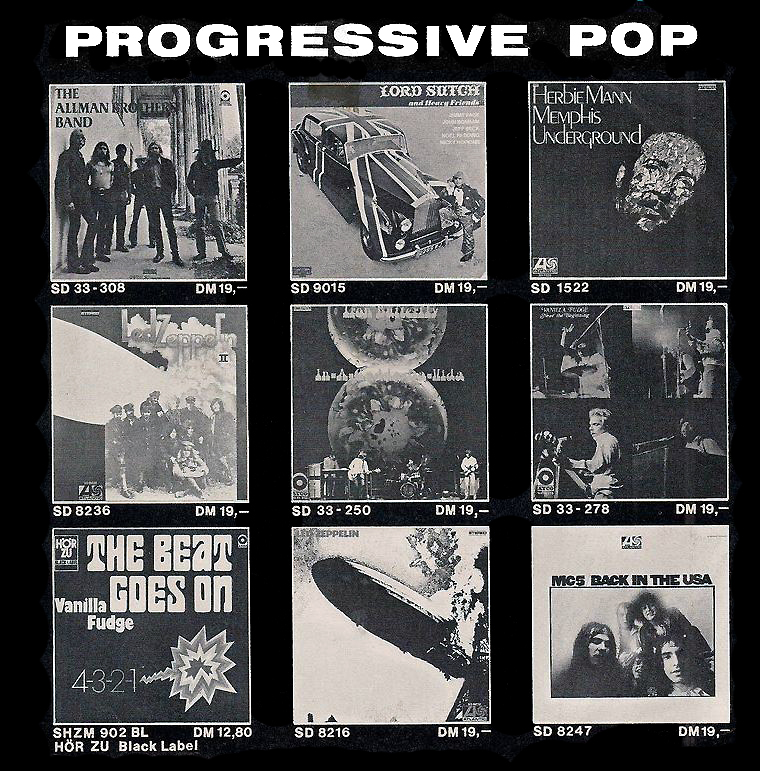
Vanilla Fudge - Selftitled (1st Album US 1967)


Size: 83.2 MB
Bitrate: 256
mp3
Found in OuterSpace
Artwork Included
Source: Japan 24-Bit Remaster

Vanilla Fudge (Atco 33-224/mono, SD 33-224/stereo) is the first album by the American psychedelic rock band Vanilla Fudge. Released in summer 1967, it consists entirely of half-speed covers and three short original instrumental compositions.

The album was Vanilla Fudge's most successful, peaking at #6 on the Billboard album charts in September 1967. An edited version of "You Keep Me Hangin' On" was released as a single and also charted.

In a debut consisting of covers, nobody could accuse Vanilla Fudge of bad taste in their repertoire; with stoned-out, slowed-down versions of such then-recent classics as "Ticket to Ride," "Eleanor Rigby," and "People Get Ready," they were setting the bar rather high for themselves. Even the one suspect choice -- Sonny Bono's "Bang Bang" -- turns out to be rivaled only by Mott the Hoople's version of "Laugh at Me" in putting Bono's songwriting in the kindest possible light. 

Most of the tracks here share a common structure of a disjointed warm-up jam, a Hammond-heavy dirge of harmonized vocals at the center, and a final flat-out jam. Still, some succeed better than others: "You Keep Me Hanging On" has a wonderfully hammered-out drum part, and "She's Not There" boasts some truly groovy organ jams. While the pattern can sound repetitive today, each song still works as a time capsule of American psychedelia.

Vanilla Fudge is an American rock band known predominantly for their psychedelic renditions of popular songs. The band's original lineup—vocalist/organist Mark Stein, bassist/vocalist Tim Bogert, lead guitarist/vocalist Vince Martell, and drummer/vocalist Carmine Appice—recorded five albums during the years 1966–69, before disbanding in 1970. The band has reunited in various configurations over the years, and is currently operating with three of the four original members, Mark Stein, Vince Martell, and Carmine Appice with Pete Bremy on bass for Tim Bogert who has retired from touring. The band has been cited as "one of the few American links between psychedelia and what soon became heavy metal".

Vanilla Fudge - Australian EP 1967
Stein and Bogert played in a local band called Rick Martin & The Showmen. The pair were so impressed by the swinging sound and floods of organ of The Rascals they decided to form their own band with Martell and Rick Martin's drummer, Joey Brennan. Originally calling themselves The Pigeons, they changed the name to Vanilla Fudge in 1966, after the replacement of Brennan by Appice.[3] The group was then "discovered" and managed by reputed Lucchese crime family member Phillip Basile, who operated several popular clubs in New York. Led Zeppelin, then an emerging band, was the opening act on their American tour. Produced by Shadow Morton who the band met through the Rascals. Morton had a gift for melodramatic productions in the studio.

The band's biggest hit was its cover of "You Keep Me Hangin' On", a slowed-down, hard rocking version of a song originally recorded by The Supremes. This version featured Stein's psychedelic-baroque organ intro and Appice's energetic drumming.

The members of Vanilla Fudge were great admirers of The Beatles, and covered several of their songs including "Ticket to Ride" and "Eleanor Rigby". The self-titled debut album quotes "Strawberry Fields Forever" at the end, with the line "there's nothing to get hung about".

On March 14, 1970, Vanilla Fudge played a farewell concert at the Phil Basille's Action House. After that, Bogert & Appice departed to form another group, Cactus (In 1972, they left Cactus and formed Beck, Bogert & Appice with guitarist Jeff Beck). Stein, left on his own, tried to keep the group going with two new players, Sal D'Nofrio (bass) and Jimmy Galluzi (drums) (both of whom had been members of a Poughkeepsie, New York group known as 'Dino & The Cavemen'). But when nothing came from this, Stein ended up forming a new group, Boomerang, instead with Galluzi.

Vanilla Fudge - Japan Single 1968
A recording of the Pigeons was released in Germany in 1973 under the title of 'While the World was Eating Vanilla Fudge'.

Following the band's breakup in 1970, the band has reunited several times. In 1982, they reunited in support of the Atco Records release, Best of Vanilla Fudge. This resulted in another album of fresh material in 1984 called Mystery. Martell was not included in this initial reunion and Ron Mancuso played guitar on Mystery instead, along with Jeff Beck, who guested under the moniker "J. Toad". Two reunion tours followed in 1987/1988. with Paul Hanson on guitar. Lanny Cordola was guitarist when the band took the stage on May 14, 1988 for the Atlantic Records' 40th Anniversary Celebration. After that, the individual members went their separate ways once again to pursue other projects.

In 1991 Appice revived the Vanilla Fudge name for a tour with Ted Nugent's former band members Derek St. Holmes (guitar, vocals), Martin Gerschwitz (keyboards, vocals) and Tom Croucier (bass, vocals), which resulted in the album The Best of Vanilla Fudge – Live.

Personnel:
♦ Carmine Appice - drums, vocals
♦ Tim Bogert - bass, vocals
♦ Vince Martell - guitar, vocals
♦ Mark Stein - lead vocals, keyboards

Studio albums:
♣ 1967 Vanilla Fudge
♣ 1968 The Beat Goes On
♣ 1968 Renaissance
♣ 1969 Near the Beginning
♣ 1969 Rock & Roll

01. "Ticket to Ride" (Lennon–McCartney) – 5:40
02. "People Get Ready" (Curtis Mayfield) – 6:30
03. "She's Not There" (Rod Argent) – 4:55
04. "Bang Bang" (Sonny Bono) – 5:20
--->Side 1 of the album ends with: "The following is a series of high-frequency tones..."
05. "Illusions Of My Childhood - Part One" – 0:20
06. "You Keep Me Hangin' On" (Brian Holland-Lamont Dozier-Eddie Holland) – 6:42
07. "Illusions Of My Childhood - Part Two" – 0:23
08. "Take Me For A Little While (Trade Martin) – 3:27
09. "Illusions Of My Childhood — Part Three – 0:23
10. "Eleanor Rigby" (Lennon–McCartney) - 8:10

1. Link
or
2. Link
.
Vanilla Fudge - German Single 1968
Vanilla Fudge - German Single 1970
Backside of Vanilla Fudge Single 1970


Sunday, December 22, 2013

Joseph Benjamin Hutto & the New Hawks - Paris 1982 (Bootleg)

J.B. Hutto & his New Hawks 22-Jul-79

Size: 307MB
Bitrate: 320
mp3
Found in my BluesMobile
Some Artwork

J.B. Hutto -- along with Hound Dog Taylor -- was one of the last great slide guitar disciples of Elmore James to make it into the modern age. Hutto's huge voice, largely incomprehensible diction, and slash-and-burn playing was Chicago blues with a fierce, raw edge all its own. He entered the world of music back home in Augusta, GA, singing in the family-oriented group the Golden Crowns Gospel Singers. He came north to Chicago in the mid-'40s, teaching himself guitar and eventually landing his first paying job as a member of Johnny Ferguson & His Twisters. His recording career started in 1954 with two sessions for the Chance label supported by his original combo the Hawks (featuring George Mayweather on harmonica, Porkchop Hines on washboard traps, and Joe Custom on rhythm guitar), resulting in six of the nine songs recorded being issued as singles to scant acclaim. 

After breaking up the original band, Hutto worked outside of music for a good decade, part of it spent sweeping out a funeral parlor! He resurfaced around 1964 with a stripped-down version of the Hawks with two guitars and drums but no bass, working regularly at Turner's Blue Lounge and recording blistering new sides for the first time in as many years.

From there, he never looked back and once again became a full-time bluesman. For the next 12 years Hutto gigged and recorded with various groups of musicians -- always billed as the Hawks -- working with electric bass players for the first time and recording for small labels, both in the U.S. and overseas. After fellow slide man Hound Dog Taylor's death in 1976, J.B. "inherited" his backup band, the Houserockers. Although never formally recorded in a studio, this short-lived collaboration of Hutto with guitarist Brewer Phillips and drummer Ted Harvey produced live shows that would musically careen in a single performance from smolderingly intense to utter chaos. Within a year, Hutto would be lured to Boston, where he put together a mixed group of "New Hawks," recording and touring America and Europe right up until his death in the mid-'80s. 

Hutto was an incredibly dynamic live performer, dressed in hot pink suits with headgear ranging from a shriner's fez to high-plains drifters' hats, snaking through the crowd and dancing on tabletops with his 50-foot guitar cord stretched to the max. And this good-time approach to the music held sway on his recordings as well, giving a loose, barroom feel to almost all of them, regardless of who was backing him.

Something made me think about J.B. Hutto a few weeks ago, and I was prompted to start replacing my old vinyl J.B. records with CDs, which you can get directly from Delmark Records, or through Amazon, and others.
I started with Keeper of the Flame, because it has one of my all-time favorites, “You Don’t Love Me,” as the leadoff track. Also, half of the disc was recorded live, which is great, because a studio recording could never capture this great guitarist’s wild live performances – he would regularly take extended walks, often on tabletops or right down the bar, using a really long guitar cord.
A particularly fond memory I have is of him at the old Jonathan Swift’s in Harvard Square, where he would actually leap from table to table, across about two feet of aisle, while playing incredible guitar solos. And then, usually at the end of a set, he would make his way back to the stage, but not before handing off his guitar to a delighted audience member.

I waited and hoped, for years, to be that lucky fan. It finally happened, in an odd setting: a bright summer day in a field off a beach somewhere near Ogunquit, Maine, (I think. It was definitely Maine or Coastal New Hampshire,) in the early 1980s.

NOTE: I just found an old photo taken that day. It was at Cape Neddick, Maine, in 1981. I wish I knew how to scan the photo, which I used in a photography course, to show you folks. Another thing Hutto was known for were his outrageous outfits, especially the hats (he’s in a bright yellow sort of puffy train conductor hat on my new CD’s cover,) In my photo, he’s wearing a relatively normal-looking fedora, but has a chain with a large owl pendant hanging from it.

Another endearing facet of Hutto was the way his vocals were pretty much incomprehensible. I still can’t sing along with most of them. (“What did he say??”)

J.B. Hutto Airline Guitar 1958
It seemed J.B. played endlessly around Boston in the late 1970s, right up until his untimely death in 1983. At only 57 years old, he apparently died of complications of diabetes, the same affliction that took the life this year of another legendary bluesman, Carey Bell, at 70 - also too soon.
But back to Hutto. I recently found out he was around Boston so much at that time because he actually moved here in the late 1970s, after a live performance from Boston's famed Tea Party was recorded. In Boston, he pieced together a new version of his band, which were always called The Hawks, and later, the New Hawks.
So where had he come here from?

I did a little research on his earlier life, and put together the following, from a great blues biographical dictionary called “Blues Who’s Who” by Sheldon Harris. (It was published in 1979, and may be out of print.) Some of the material also comes from a 2001 article from Blues Notes by Greg Johnson.
Hutto was born on a farm in Blackwell, South Carolina, as Joseph Benjamin Hutto, on April 26, 1926. One of 12 children, some sources claim that he was born in Augusta, Georgia, but his family moved there when young Joseph was three years old. His father was a deacon at a local church.

It was in Augusta that he first came into contact with music, teamed with three brothers and three sisters in a family group known as The Golden Crown Gospel Singers, which worked in area churches. But J.B claimed he never had any true desire to perform musically until after his family relocated to Chicago, in the 1940s, following the death of his father.

Once in Chicago, Hutto took up both the piano and drums. He also heard blues for the first time and, by the mid-1940s, he was working professionally with local bluesman, Johnny Ferguson and his band, The Twisters. At the time he was the band's drummer and occasional vocalist. He started to develop an interest in the guitar and would practice, using Ferguson's guitar, between sets. He also began to frequently perform at the city's famed open-air market on Maxwell Street on weekends, often working as a guitarist with the one-man band Porkchop, AKA Eddie Hines.

In 1950, J.B. met Elmore James and quickly became entranced by James' bottleneck style. He began to follow him whenever he could and studied his method of playing and singing. From the outset of teaching himself to play guitar, Hutto had always used an electric. But, after hearing James, his work would only consist of slide-playing thereafter. His style, like many other blues superstars, is considered electrified Delta slide blues.
Hutto, who was also influenced by T-Bone Walker, Robert Nighthawk, and Muddy Waters, formed a band in the early 1950s with himself as guitarist/vocalist, Porkchop on washboard, Joe Custom on second guitar and George Mayweather on harmonica. They were the first Hawks, and were given the opportunity to record for Chess' subsidiary label, Chance, in 1954, holding two sessions that resulted in a total of nine numbers.
But the public reception was only minor, perhaps mostly due to the ever-changing taste of the buying public at the time.

J.B. started to become disenchanted with performing, due to the lack of success he had hoped for. The last straw happened one night while playing in a club. A couple began to fight in the audience, and the woman involved grabbed J.B’s guitar, breaking it over her husband's head. That was enough for Hutto. He walked away from music for the next 11 years, supplementing his income by working as a janitor in a funeral home.
It was the death of his mentor, Elmore James, in 1963 that first made Hutto think about playing again, and he returned the following year. He put together a new gathering of Hawks, including drummer Frank Kirkland and bass player Herman Hassell, also frequently working with Johnny Young and Big Walter Horton. The group soon became the house band for Turner’s Blues Lounge in Chicago, and Hutto released an album, Master Of Modern Blues, in 1966 for Testament Records, which featured Young, Horton, bassist Lee Jackson and drummer Fred Below, who also played with Little Walter and Howlin’ Wolf.

In 1967, Delmark released the milestone compilation, Chicago/The Blues/Today! It prominently showcased J.B. Hutto and the Hawks on five cuts, considered by many to be some of the premier pieces of his career. Delmark responded to the popularity of this album by releasing Hutto’s first full-length solo disc the next year, the brilliant masterpiece Hawk Squad. Over the next 16 years, Hutton recorded with a variety of labels that would include JSP, Varrick and Wolf, releasing classic recordings such as 1973's, Slidewinder, and 1983's, Slippin' & Slidin.
Hutto’s good friend Hound Dog Taylor, died in 1975 and it was J.B’s fortune to inherit Taylor’s band, The Houserockers. (This was the only time during Hutto’s career where he performed with a backing unit called anything other than The Hawks.) The band never truly gelled as a group, however, and did not record.
After Hutto’s death, his popularity – he was one of the largest-drawing bluesmen at the time - was obvious by his induction into the Blues Foundation’s Hall of Fame just two years after his death.

So, I guess I’ve got to keep on replacing those old J.B. records with CDs. And you younger folks who didn’t have the opportunity to see him live should check out those old discs, too.

By the way, the liner notes on the Keeper of the Flame disc were written by Cambridge’s own “Stereo Jack” Woker, who if memory has not faded away completely, owned “Cheapo Records” in Central Square, Cambridge.

open picture in a new window for
100% size
Biography:
Blues guitarist, vocalist, songwriter and bandleader Dave Weld got his start on Chicago's West Side in the late ‘70s. At the 1815 Club on Roosevelt Road, Dave was in the house band with Chico Chism, Shorty Gilbert, Hubert Sumlin, Detroit Junior and Eddie Shaw. Dave played there with Otis Rush, Guitar Junior, Tail Dragger, Little Arthur, Johnny Littlejohn and more. Weld was under the tutelage of Grammy winning slide guitarist J.B. Hutto.  J.B introduced Dave to his nephew, Lil’ Ed. They started the band Lil’ Ed and the Blues Imperials and played every joint on the West Side for ten years. Burnin' Love is Weld's Delmark debut and it features Li’l Ed on guitar and the legendary Abb Locke on saxophone.

The first time I met J.B. Hutto was in a dream!  I was in high school, in a north suburb, and one night in a restless sleep, I found myself face to face with a short black man, in a suit with a broad infectious smile playing guitar in a style I had never seen before.  He was featured American Bandstand style in an enclosure that provided lighting, and he was working incessantly at the frets of his guitar with a piece of metal, playing and all the while smiling directly at me!

I thought about that haunting dream all the next day at school.  I had been in the process of trading my John Mayall records for Lightnin’ Hopkins’ "Black Cadillac Blues" and Howlin' Wolf's "Big City Blues".  But I never forgot that dream, until the day I found McKinley Morganfield's name on the back of a Rolling Stones album, and learned that he was called Muddy Waters, and that piece of metal was called a slide, like in my dream, and that's what made Muddy's sound so different!

Years later in 1975, I walked into the Wise Fools Pub on north Lincoln in Chicago, and there was a short guy, in a suit with a broad infectious smile, onstage playing the sweetest slide I had ever heard, with a booming voice and a style different from Hound Dog's, both clean and dirty at the same time. I was touched inside, where joy meets harmony, as in the dream I’d had years earlier, and on the break I walked up to introduce myself.  The band members, Lee Jackson on guitar and Bombay Carter on bass, sidled up to the bar to get a drink. 

Various Artist - Front Cover 1966
J.B. did not drink anymore, because of diabetes.  He was a humble, perceptive and receptive man, and I was surprised at how friendly and open he was, but then I did not know about the other kinds of people he had to deal with; I must have been a nice change of pace for him.

J.B. had been arrested once by Chicago police for drunk driving, but it was really the blood sugar raging out of control that made him weave.  I ran into one person, years later, who said, "Yeah, J.B. smokes a little weed", but I never saw it all those years I was with him, and at his home.

I hung out with J.B. that night and he extended a hand, helping as a mentor and friend, teaching me guitar, both lead and backup. I spent years at his home in Harvey IL, and he introduced me to my first band, Hound Dog Taylor’s Houserockers, Ted Harvey and Brewer Phillips. They had ended up with J.B. after Hound Dog’s death in 1975.  We played for a year at Sweet Pea's on 47th and Ingleside, while J.B. was on the road based out of Boston, where he moved in the late ‘70s.

Ted and Harvey had been touring with J.B. out East but he fired them after a big fight. Guitarist Jimmy Thackery, then with the Nighthawks, told me the story about the fight.  It happened in the dawn’s light, in a calm, white neighborhood with J.B. wearing his sequined Shriners hat and African outfit. He was struggling with Brewer, guns drawn but not used, and the police were called.  This left Ted and Brewer free so I could join them for my first pro gig for a year at Sweet Pea's, a South Side club where I could get beat up, or married, in the same night for being white.

It was that same extended helping hand that introduced me to his nephews, Lil’ Ed and James “Pookie” Young, so we could start the Blues Imperials.  It was that same helping hand in 1983 that played imaginary notes, fingering them in the air, in his cancer ward death bed, while I played guitar next to him.  We both agreed that I missed a few notes, and when I told him that I had bought a new car, he looked me dead in the eye and said "but it’s not for the band right?"  Later that week he died.

Some of J.B.'s best stuff came out in 1954 on 78s from Chance Records, and they were some rough, raw cuts with slide guitar and gutbucket blues that groove to this day: "Pet Cream Man," "Lovin’ You,"  "Now She's Gone," and "Combination Boogie" with Joe Custom on second guitar, “Earring” George Mayweather on raucous harp, and Eddie “Porkchop” Hines on washboard and drums.  Elmore James’ piano man, Johnny Jones, recorded with them for five more cuts including "Things Are So Slow" (which we just covered for our new Delmark CD Burnin’ Love).  J.B. is best known for his records with Delmark: Hawk Squat, Slidewinder and Stompin’ at Mother Blues.  He also recorded for the Vanguard, Testament and Varrick labels.

J.B. could sing!  He came up in the church. Born Joseph Benjamin Hutto in 1926 in Blackville, S.C., his father Calvin was a preacher who moved the family to Augusta, GA when J.B. was three. He and his three brothers and three sisters formed a gospel group, The Golden Crowns, who were popular in local churches.  Back then he was singin' high, because his guitar was tuned to open E, but later Lee Jackson showed him how to tune down to D, so J.B. could play open tuning  or "spanish" and sing lower, which is easier to do as you age,  or have to sing all night.  This is what got me started playing in D.

So when J.B. beckoned, "ride with me" for a gig on the West Side, I said “sure”. It was to a party held in a banquet hall hosted by Hound Dog Taylor’s widow’s social club, and J.B. wanted to show me the ropes. I sat in the car with the band (different guys from the Wise Fools and NOT the Houserockers) and while J.B. took care of business, they passed a pint around.  I noticed the bass man gave the drummer a pill, but I did not think anything of it.  They loaded in and hit the stage, sounding pretty good, opening the show for J.B., all the while playing a tight, professional set with the black crowd clapping, dancing and calling out!

J.B. came up after about four songs, and things started to change.  J.B. was always so intense with his music, sliding and singing, but he started to notice the beat changing and looking back to see what was wrong; he changed songs thinking it would go better, but it was worse.  By now everyone was looking at the drummer, who was missing time and disoriented.  Soon vomit billowed out of the drummer’s mouth onto the snare drum in a puddle, but instead of falling off the throne, he passed out with his face in the puddle, his arms hanging loosely down from the snare, with dinner more than just a recent memory.  After a short while the guys stopped playing.

J.B. did clean it up and, amazingly, found another drummer to make the night.  I could tell by the way he was talking to Hound Dog’s widow, how bad he felt, and later that night, after the gig, J.B. pointed out some band leader facts.  "See how good they sounded, until I got up there", and sure enough, they soon left J.B. as a unit, taking their cheap little gigs with them, leaving behind a decent and intelligent future Blues Hall of Famer and international bluesman to clean up the mess, find another band, move to Boston, win a Grammy, and tour the globe.

That's one reason J.B. said, "you'll always struggle, you got to leave this town", and so I put  his advice in my song "Ramblin'" the second cut of our Delmark CD Burnin' Love.  Delmark was good to J.B., and J.B. was loved by Delmark, Bob Koester and his wife Sue, who have been running the label with great success for over 55 years.  I’m the guy Koester calls "J.B.'s bastard son". That's me, and yes J.B., I got the guys a van! [Source: http://www.chicagobluesguide.com/]

J.B.HUTTO, PARIS, Mutualité May 10 1982

First Set
01. announcer
02. instrumental by the band
03. big bad moon (sung by Sarah Brown)
04. high and lonesome 
05. instrumental
06. love retirement
07. hide and seek
08. i feel so good
09. mother in law blues
10. instrumental
11. walking the backstreets and crying

Second Set and Encore
01. set intro, summertime
02. mad woman ?
03. unknown
04. hip shakin'
05. instrumental
06. instrumental
07. Frankie and Johnny
08. i've got a right to love my baby
09. boogie jam in the crowd 
10. caldonia

Part 1: Link
Part 2: Link
or
Part 1: Link
Part 2: Link
.

Saturday, December 21, 2013

Not to be missed, believe me: Joseph Benjamin Hutto & the New Hawks - The Unreleased Album (1982-1984 (Bootleg)


Size: 84.6 MB
Bitrate: 320
mp3
Found in my BluesMobile
Some Artwork

J.B. Hutto (April 26, 1926 – June 12, 1983) was an American blues musician. Hutto was influenced by Elmore James, and became known for his slide guitar work and declamatory style of singing. He was inducted into the Blues Hall of Fame two years after his death.

Joseph Benjamin Hutto was born in Blackville, South Carolina, United States, the fifth of seven children. His family moved to Augusta, Georgia when Hutto was three years old. His father, Calvin, was a preacher and Hutto, along with his three brothers and three sisters, formed a gospel group called The Golden Crowns, singing in local churches. Hutto's father died in 1949, and the family relocated to Chicago. Hutto served as a draftee in the Korean War in the early 1950s, driving trucks in combat zones.

Joseph Benjamin Hutto & the New Hawks  - Album 1968
In Chicago, Hutto took up the drums and played with Johnny Ferguson and his Twisters. He also tried the piano before settling on the guitar and playing on the streets with the percussionist Eddie 'Porkchop' Hines. After adding Joe Custom on second guitar, they started playing club gigs, and harmonica player George Mayweather joined after sitting in with the band. Hutto named his band The Hawks, after the wind that blows in Chicago.[4] A recording session in 1954 resulted in the release of two singles on the Chance label and a second session later the same year, with the band supplemented by pianist Johnny Jones, produced a third.

Later in the 1950s Hutto became disenchanted with music, and gave it up after a woman broke his guitar over her husband's head one night in a club where he was performing; during the next eleven years Hutto worked as a janitor in a funeral home to supplement his income. He returned to the music industry in the mid-1960s, with a new version of the Hawks featuring Herman Hassell on bass and Frank Kirkland on drums. His recording career resumed with, first, a session for Vanguard Records released on the compilation album Chicago/the Blues/Today! Vol. 1, and then albums for Testament and Delmark. The 1968 Delmark album, Hawk Squat!, which featured Sunnyland Slim on organ and piano, and Maurice McIntyre on tenor saxophone, is regarded as his best work on album up to this point.

J.B. Hutto - Trading Card
(click on picture for bigger size)
After Hound Dog Taylor died in 1975, Hutto took over his band the Houserockers for a time, and in the late 1970s he moved to Boston and recruited a new band which he called the New Hawks, with whom he recorded further studio albums for the Varrick label. His 1983 Varrick album Slippin' & Slidin', the last of his career and later reissued on CD as Rock With Me Tonight, has been described as "near-perfect". J.B.Hutto also Lived in Harvey in the Marshfeild Ave as a step Grandfather while together with Lula Bell Black, he practice with his Guitar in his hands and his step Grandson on his patting feet, I remember him as good man, he was all ways good to my Grandmother.

Hutto returned to Illinois in the early 1980s, where he was diagnosed with cancer. He died in 1983, at the age of 57, in Harvey. He was interred at Restvale Cemetery, Alsip, Illinois.

In 1985, the Blues Foundation inducted Hutto into its Hall of Fame. His nephew, Lil' Ed Williams (of Lil' Ed and the Blues Imperials) has carried on his legacy, playing and singing in a style close to his uncle's.
A "J.B. Hutto" model guitar is often used to refer to a mid-1960s, red, Montgomery Ward Res-O-Glas Airline guitar. Although he was not a paid endorser, Hutto made the guitar famous by appearing with it on the cover of his Slidewinder album.

Jack White of the White Stripes is another artist famous for using theMontgomery Ward Res-O-Glas Airline guitar.

01. Sweet Young Thing  02:59
02. Unknown  05:05
03. Recycled Woman  03:33
04. Hide & Seek (live) 05:34
05. Instrumental  03:30
06. Unknown  05:54
07. Whas the Matter with the Mill (live)  05:36
08. Unknown  04:43

1. Link
or
2. Link
.
 Joseph Benjamin Hutto & the New Hawks - Unreleased Album Recorded 1982-1984. Recorded for Baron Records. None of these tracks have ever been released. 
.
Joseph Benjamin Hutto & the New Hawks  - Promo Photo

Friday, December 20, 2013

Booker T - Evergreen (Great R&B, Rock US 1974)


Size: 84 MB
Bitrate: 256
mp3
Ripped by: ChrisGoesRock
Artwork Included

Playing organ and keyboards in the MG's, one the greatest R&B and soul bands in the history of pop music, Booker T. Jones was no stranger to the pop world when he recorded Evergreen in 1974. As part of the MG's, he played on innumerable Stax Records sessions backing everyone from Otis Redding to Sam & Dave, and the MG's hit the charts a few times themselves, beginning with the timeless "Green Onions" instrumental in 1962. But things began going south for Stax in the early '70s, and Jones could see the writing on the wall, leaving the label well before it filed for bankruptcy in 1975 and signing with A&M Records in 1971 and consequently releasing a series of albums with his then-wife Priscilla Coolidge. 

He signed with Epic Records in 1974, issued Evergreen, and then returned to A&M Records. Evergreen isn't a soul record, at least not the way the MG's did it, and Jones wore several hats at the sessions, playing some guitar and bass on it in addition to organ and keyboards, handled most of the vocals, and also wrote, arranged, and produced all the tracks (with the exception of a cover of Kris Kristofferson's "Why Me"). It's really a laid-back roots album, and one doesn't get any of Jones' famous organ playing until the fourth cut, an instrumental called "Flamingo," and it's there on the title track, "Evergreen," as well, but most of the album is a light-breezed mix of folk melodies, subtle calypso, and reggae rhythms, ragtime, and what is know these days as soul-jazz, and it's all very pleasing, but far from the greasy soul-funk sound of the MG's. Wounded Bird Records reissued Evergreen in 2013, adding in six bonus tracks, which included the single version of "Evergreen" and interesting cover versions of "Take Me to the River" and "Whiter Shade of Pale," none of which change the overall mood and feel of the original album.

Booker T. Jones (born November 12, 1944) is an American multi-instrumentalist, songwriter, record producer and arranger, best known as the frontman of the band Booker T. & the M.G.'s. He has also worked in the studios with many well-known artists of the 20th and 21st centuries, earning him a Grammy Award for lifetime achievement.

Booker T. Jones was born in Memphis, Tennessee, in 1944. He was named in honor of his father, Booker T. Jones, Sr., who was named in honor of Booker T. Washington, the educator; "Booker Taliaferro Jones, Jr." is his full name.

Jones was a prodigy, playing the oboe, saxophone, trombone, and piano at school and serving as organist at his church. He attended Booker T. Washington High School, the alma mater of Rufus Thomas and shared the hallowed halls with future stars like Isaac Hayes's writing partner David Porter; saxophonist Andrew Love of The Memphis Horns; soul singer/songwriter William Bell and Earth, Wind, & Fire's Maurice White.

Jones's first entry into professional music came at age sixteen, when he played baritone saxophone on Satellite (soon to be Stax) Records' first hit, "Cause I Love You", by Rufus Thomas and Carla Thomas.

While hanging around the Satellite Record Shop run by Estelle Axton, co-owner of Satellite Records with her brother Jim Stewart, Jones met record clerk Steve Cropper, who would become one of the MGs when the group formed in 1962. Besides Jones on organ and Cropper on guitar, Booker T. and the MGs featured Lewie Steinberg on bass guitar and Al Jackson, Jr. on drums (Donald "Duck" Dunn eventually replacing Steinberg). While still in high school, Jones co-wrote the group's classic instrumental "Green Onions", which became a hit in 1962.
Bob Altshuler wrote the sleeve notes on the first Booker T. & the M.G.'s album released by Stax Records in 1962 and also called Green Onions:

Booker T. And The M.G's - Netherland Single 1968
[His] musical talents became apparent at a very early age. By the time he entered high school, Booker was already a semi-professional, and quickly recognized as the most talented musician in his school. He was appointed director of the school band for four years, and in addition, organized the school dance orchestra which played for proms throughout the Mid-South. In the classroom, he concentrated on the studies of music theory and harmony. ... Booker's multiple activities earned him a coveted honour, that of being listed in the students' "Who's Who of American High Schools". Booker's first instrument was the string bass, but he soon switched to the organ. Booker came to the attention of record executive Jim Stewart in Memphis, and while still in high school, he worked as a staff musician for Stax Records, appearing as sideman on many recording dates for that label. It became obvious that one day Booker would be ready to record under his own name and several months later Booker's first recording session was set.

Over the next few years, Jones divided his time between studying classical music composition, composing and transposition at Indiana University, playing with the MGs on the weekends back in Memphis, serving as a session musician with other Stax acts, and writing songs that would become classics. He wrote, with Eddie Floyd, "I've Never Found a Girl (To Love Me Like You Do)", Otis Redding's "I Love You More Than Words Can Say", and, with William Bell, Albert King's "Born Under a Bad Sign". The latter would later be popularized in the cover version by power trio Cream.

Booker T and The M.G.S. Poster 1968
In 1970, Jones moved to California and stopped playing sessions for Stax, after becoming frustrated with Stax's treatment of the MGs as employees rather than musicians. While still under contract to Stax, he appeared on Stephen Stills' eponymous album (1970). The 1971 album, Melting Pot would be the last Booker T. & the MGs album issued on Stax.

Making the charts as a solo artist in 1981 with "I Want You", he produced Rita Coolidge, Bill Withers's debut album Just As I Am (on which he also played several instruments), and Willie Nelson's album Stardust. He has also lent his trademark keyboards to artists ranging in genre from Ray Charles to Neil Young.

On June 18, 1985 Booker married Nanine Warhurst. They have three children together, Olivia, Cicely, and Teddy. All total they have a family of eight children, including Booker T. III, Lonnie, Matthew, Brian, and Michael.
On March 1, 1995 Booker T. & the MG's won their first Grammy Award for Best Pop Instrumental Performance for "Cruisin'". Jones still plays with Booker T. & the MGs and his own Booker T. Jones Band. Booker's current touring group includes Vernon "Ice" Black (guitar), Darian Gray (drums), and Melvin Brannon (bass).
Jones was inducted into The Rock and Roll Hall of Fame in 1992, and was honored with a Grammy Award for lifetime achievement on February 11, 2007.

In 2007, Jones was inducted into the Musicians Hall of Fame and Museum in Nashville, TN.
In 2009 he released a new solo album, Potato Hole, recorded with the Drive By Truckers, and featuring Neil Young. He performed at the Bonnaroo Festival with Drive By Truckers on June 6, 2009, with a set including most tracks from Potato Hole as well as some Truckers tracks. On January 31, 2010, Potato Hole won the Best Instrumental Album award at the 52nd Grammy Awards.

He is featured on the new Rancid album, Let The Dominoes Fall, playing a Hammond B-3 on the track "Up To No Good".

Jones also played his B-3 on the track "If It Wasn't For Bad" from the Elton John and Leon Russell collaboration album titled The Union. The track was nominated at 53rd Annual Grammy Awards for Best Pop Collaboration With Vocals.

In 2011, Jones released The Road from Memphis. The backing band included Questlove (drums), "Captain" Kirk Douglas (guitar) and Owen Biddle (bass) from The Roots as well as former Motown guitarist Dennis Coffey and percussionist Stewart Killen. The album features vocals by Yim Yames, Matt Berninger, Lou Reed, Sharon Jones and Booker T. himself, as well as lyrics contributed by his daughter/manager Liv Jones.

On February 12, 2012 The Road from Memphis won at the 54th Grammy Awards for Best Pop Instrumental Album. Jones holds a total of 4 Grammy Awards.

Jones received an honorary doctorate degree from Indiana University's Jacobs School of Music at the 2012 undergraduate commencement exercises on Saturday, May 5, 2012. He had originally attended Indiana University in the 1960s, even after having recorded hits for Stax Records.

Jones was featured on organ for singer Kelly Hogan on Hogan's 2013 release on Anti- records, "I Like to Keep Myself in Pain."

In June, 2013, Jones released his 10th album, Sound The Alarm, on Stax Records. It features guest artists Anthony Hamilton, Raphael Saadiq, Mayer Hawthorne, Estelle, Vintage Trouble, Luke James, James Jay, and Booker's son Ted Jones. [AMG + Wikipedia]

01. Jamaica Song  2:25
02. Mama Stewart  2:52
03. Tennessee Voodoo  4:46
04. Flamingo  3:38
05. Song For Casey  4:52
06. Evergreen  6:30
07. Country Days  4:35
08. Why Me  3:35
09. Front Street Rag  2:14
10. Lie To Me  6:00

1. Link
or
2. Link
.

Thursday, December 19, 2013