Followers

Friday, March 09, 2018

Faces - First Step (Wrong Name - "Small Faces" in The US 1970)


Size: 230 MB
Bitrate: 320
mp3
Ripped by: ChrisGoesRock
Source: SHM-CD Limited Remaster
Artwork Included

First Step was the first album by the British group Faces, released in early 1970. The album was released only a few months after the Faces had formed from the ashes of the Small Faces (from which Ronnie Lane, Kenney Jones and Ian McLagan hailed) and The Jeff Beck Group (from which Rod Stewart and Ronnie Wood hailed.) The album is credited to the Small Faces on all North American issues and reissues, while record labels for initial vinyl printings give the title as The First Step.


The album cover shows Ronnie Wood holding a copy of Geoffrey Sisley's seminal guitar tutorial First Step: How to Play the Guitar Plectrum Style.

The album was recorded at De Lane Lea Studios in London very soon after the group's official formation (although the band members had been performing together in various combinations since April 1969). At 47:13 it is the band's lengthiest original release and many critics regard it as promising, but sprawling and unfocused - their least cohesive and most undisciplined offering. Accordingly the album reached no higher than #119 on the Billboard charts. 


It is perhaps the most democratic of the Faces releases, affording as it does each member of the group at least one composer credit. Highlights include Ronnie Lane's folksy "Stone", the hard-rocking "Shake, Shudder, Shiver", "Three Button Hand Me Down" (on which both Lane and Wood play the bassline, affording the track a unique sonic quality in the Faces catalogue), and the soulful "Flying".


The notorious sloppiness of the Faces was apparent on their debut, almost moreso on the cover than on the music, as the group was stilled billed as the Small Faces on this 1970 debut although without Steve Marriott in front, and with Rod Stewart and Ron Wood in tow, they were no longer Small. They were now larger than life, or at least mythic, because it's hard to call an album that concludes with a riotous ode to a hand-me-down suit as larger than life. That was the charm of the Faces, a group who always seemed like the boys next door made good, no matter where next door was. 

Part of the reason they seemed so relatable was that legendary messiness -- after all, it's hard not to love somebody if they so openly displayed their flaws -- but on their debut, it was hard not to see the messiness as merely the result of the old Faces getting accustomed to the new guys. 


Fresh from their seminal work with Jeff Beck, Rod and Ron bring a healthy dose of Beck's powerful bastardized blues, bracingly heard on the opening cover of "Wicked Messenger," but there's a key difference here; without Beck's guitar genius, this roar doesn't sound quite so titanic, it hits in the gut. 


That can also be heard and Rod and Woody's "Around the Plynth," or "Three Button Hand Me Down," which is ragged rocking at its finest. 

Combine that with Ronnie Lane and Ian McLagan finding their ways as songwriters in the wake of the Small Faces' mod implosion, and this goes in even more directions. Lane unveils his gentle, folky side on "Stone," McLagan kicks in "Looking Out the Window" and "Three Button Hand Me Down." 

All these are moments that are good, often great, but the record doesn't quite gel, yet that doesn't quite matter. 

The Faces is a band that proves that sometimes loose ends are as great as tidiness, that living in the moment is what's necessary, and this First Step is a record filled with individual moments, each one to be savored.

The Album US 1970:
01. Wicked Messenger - 04.07
02. Devotion - 04.56
03. Shake, Shudder, Shiver - 03.14
04. Stone - 05.38
05. Around the Plynth - 05.51
06. Flying - 04.17
07. Pineapple and the Monkey - 04.24
08. Nobody Knows - 04.05
09. Looking Out the Window - 05.01
10. Three Button Hand Me Down - 05.48

Bonus Tracks:
11. Behind the Sun (Outtake) - 05.29
12. Mona - The Blues (Outtake) - 05.05
13. Shake, Shudder, Shiver (BBC Session) - 02.46
14. Flying (Take 3) - 04.41
15. Nobody Knows (Take 2) - 04.42

Rod Stewart Bonus Tracks:
16. Rod Stewart - Good Morning Little Schoolgirl [UK 1964] - 02.09
17. Rod Stewart - I'm Gonna Move to the Outskirts of Town [UK 1964] - 02.54
18. Rod Stewart - The Day Will Come [UK 1965] - 02.45
19. Rod Stewart - Why Does It Go On [UK 1965] - 02.47
20. Rod Stewart - Shake [UK 1966] - 02.50
21. Rod Stewart - I Just Got Some [UK 1966] - 03.40
22. Rod Stewart - Little Miss Understood [UK 1968] - 03.38
23. Rod Stewart - So Much To Say [UK 1968] - 03.14

Part 1: Faces
Part 2: Faces
or
Part 1: Faces
Part 2: Faces
or
Part 1: Faces
Part 2: Faces

Tuesday, March 06, 2018

Article for the day...

California 'Dream-in' Billboard Magazine Jule 1967

Ash Ra Tempel - Selftitled (Great German Progressive Rock 1971)


Size: 94 MB
Bitrate: 256
mp3
Ripped by: ChrisGoesRock
Artwork Included
Source: Japan SHM-CD Remaster

The group was originally founded by guitarist Manuel Göttsching, keyboardist/drummer Klaus Schulze, and bassist Hartmut Enke in 1971. All three founding members had previously played together as part of the short-lived group Eruption founded by Conrad Schnitzler. Prior to that Schnitzler and Schulze had worked together in Tangerine Dream.


A short-lived project Manuel Göttsching had in 1970 was the Steeple Chase Blues Band, which also included Hartmut Enke, Wolfgang Müller, and Volker Zibell.

Ash Ra Tempel released its self-titled debut album in June 1971. This release is considered by critics to be a classic of the genre; Schulze temporarily departed for a solo career shortly after its release. Schwingungen (1972), Seven Up (with Timothy Leary) (1972), and Join Inn (1973) are all considered key works from the band. The pop-oriented 1973 album Starring Rosi was thus named because it featured lead vocals by Rosi Mueller.


Their music is widely characterized as cosmic and atmospheric. The early albums were more psychedelic-oriented and all had one lengthy track per side: one more powerful and dramatic, the other of a more atmospheric nature.

Ash Ra Tempel's last concert performance took place in Cologne in February 1973.

Later, after recording the soundtrack Le Berceau de Cristal (1975; unreleased until 1993) Ash Ra Tempel shortened its name to Ashra, making a more melodic, synthesizer-based music. In 2000 the band was reunited in the line up of Manuel Gottsching and Klaus Schulze. The pair had previously worked together on Schulze's album In Blue.

01."Amboss" – 19:40
02."Traummaschine" – 25:24

1. Ash Ra Tempel
or
2. Ash Ra Tempel
or
3. Ash Ra Tempel


Extradition - Hush (Australian Acid Folkrock 1971)


Size: 92.6 MB
Bitrate: 256
mp3
Ripped by: ChrisGoesRock
Artwork Included
Source: Japan 24-Bit Remaster

Hush, the original vinyl album recorded by Sydney group Extradition, remains one of the most rarest albums released by an Australian artist. Prices several years ago were above $100, but unlike many other albums of the early seventies, this album is not rock nor blues orientated. Instead it mixes folk, traditional folk with avant garde ideas, yet remains very listenable, even to this day. 


Having been to several folk festivals over the past few months, I can attest that several of their songs reflect the influence of English folk, particularly when vocalist Shayna Karlin takes on lead vocals: she has a classic, clear vocal sound reminiscent of Sandy Denny of Fairport Convention, although other scribes suggest Pentangle and Incredible String Band might also be other comparison reference points. 

I also hear nuances of Steeleye Span. However it is the creative input from Colin Campbell and Colin Dryden that pushes the normal boundaries of folk towards more less travelled paths. On tracks like Original Whim, drummer Robert Lloyd, uses unusual percussive instruments and rhythms, without losing the interest of the listener. Lloyd later became more interested in World music, which he explored at the time in 1971, before World music became a recognised genre. The band also used unusual instruments such as a harmonium (on the classical instrumental Minuet) or the sitar sounding vina on A Woman Song. Other instruments include bamboo flute, glass chimes, harpsichord and gongs. This re-issue of the original album includes 6 bonus tracks, all from a live recording of the band in concert. For my money two of these constitute the best tracks on the album. Honeychild and In the Evening are a traditional folk song and the latter is a cover, in the blues folk idiom. 


Ballad of Reading Gaol is a poem of Oscar Wilde set to music, and they do a very creditable version of Tom Paxton's Hold On to Me Babe. Dear One is a homage to the band's spiritual leader, Meher Baba. The melody is very strong and if you can ignore the lyrics - ie if you are not a convert, this is a very pleasant outing. I liked the use of the male chorus underpinning of A Moonsong. The 16 page booklet which accompanies the set, is among the best liner notes of any re-issue album in the country, putting all the major labels to shame yet again. 

Ian McFarlane has done a great job researching the release by tracking down most of the original members and including comments and excerpts from their interviews. Despite the obscure nature of the original release, this album deserves to be heard by a much larger audience. However don't expect to hear a progressive rock band; this is slow paced, gentle folk and washes of sound. Still this CD re-issue should be of interest to any collector of seventies' music. 

01. A Water Song 
02. A Love Song
03. Original Whim
04. Minuet
05. A Moon Song
06. Dear One
07. A Woman Song
08. I Feel The Sun
09. Ice
10. Song For Sunrise

1. Extradition
or
2. Extradition
or
3. Extradition

Sunday, February 25, 2018

Timothy Leary & Ash Ra Tempel - Seven Up (German Progressive Rock 1972)


Size: 85.4 MB
Bitrate: 256
mp3
Ripped by: ChrisGoesRock
Artwork Included
Source: Japan SHM-CD Remaster

Seven Up, Ash Ra Tempel's third album is often very misunderstood by fans of their music. It's a real odd one to say the least, and if you're familiar with such albums as their 1971 debut, Join Inn (1973), or Inventions For Electric Guitar (1975, actually a Manuel Göttsching solo album) this one is quite a shock indeed. By this point, trying to figure out who was in the group has became pretty pointless. Guitarist Manuel Göttsching and bassist Hartmut Enke are still here, with tons of different vocalists, and ex-Tangerine Dream organist Steve Schroyder (he played on Alpha Centauri and guested on Zeit). 


The album starts off with "Space". It's a suite divided in to four movements. It starts off with "Downtown", which doesn't sound too encouraging. It sounds like downright generic blues sung by a female vocalist, but never let that deceive you. You quickly face some truly mind blowing spacy electronic effects and noise that never lets up! It's pretty much the same throughout, although three more blues songs will follow, but as always, the blues songs never last because it sounds like the band was just so stoned at the time, they'd rather blow people's mind. I can sense quite a bit of irony in the way the band played those blues numbers. 

Thanks to the presence of Timothy Leary (who was in exile in neighboring Switzerland), it's no surprise that this music is the effects of an LSD trip. The second half of the album is taken up by a three movement suite called "Time". Here's where detractors of the album finds its redeeming qualities, as this is very much like like Alpha Centauri-era Tangerine Dream. The last movement of "Time" is "She" which is basically a re-recording of "Suche & Liebe" off Ash Ra Tempel's 1972 album Schwingungen. This is a wonderful, and underrated album, which if you approach with an open-mind you'll probably enjoy it.

Ash Ra Tempel are a German krautrock group of the 1970s, and are an example of cosmic or space rock.

The group was originally founded by guitarist Manuel Göttsching, keyboardist/drummer Klaus Schulze, and bassist Hartmut Enke in 1971. All three founding members had previously played together as part of the short-lived group Eruption founded by Conrad Schnitzler. Prior to that Schnitzler and Schulze had worked together in Tangerine Dream.

A short-lived project Manuel Göttsching had in 1970 was the Steeple Chase Blues Band, which also included Hartmut Enke, Wolfgang Müller, and Volker Zibell.


Ash Ra Tempel released its self-titled debut album in June 1971. This release is considered by critics to be a classic of the genre; Schulze temporarily departed for a solo career shortly after its release. Schwingungen (1972), Seven Up (with Timothy Leary) (1972), and Join Inn (1973) are all considered key works from the band. The pop-oriented 1973 album Starring Rosi was thus named because it featured lead vocals by Rosi Mueller.

Their music is widely characterized as cosmic and atmospheric. The early albums were more psychedelic-oriented and all had one lengthy track per side: one more powerful and dramatic, the other of a more atmospheric nature. Instead of writing English lyrics, since German language was not popular in rock music at the time, Ash Ra Tempel more or less decided not to have lyrics in their songs.

Ash Ra Tempel's last concert performance took place in Cologne in February 1973.

Later, after recording the soundtrack Le Berceau de Cristal (1975; unreleased until 1993) Ash Ra Tempel shortened its name to Ashra, making a more melodic, synthesizer-based music. In 2000 the band was reunited in the line up of Manuel Gottsching and Klaus Schulze. The pair had previously worked together on Schulze's album In Blue

01.a  Downtown   16:00
01.b  Power Drive    
01.c  Right Hand Lover    
01.d  Velvet Genes    
02.a  Timeship   21:36 
02.b  Neuron    
02.c  She  

or
or

Saturday, February 24, 2018

Mike Bloomfield - Live at Bill Graham's Filmore West (US 1969)


Size: 136 MB
Bitrate: 256
mp3
Ripped by: ChrisGoesRock
Artwork Included
Source: Japan BLU-SPC CD2 Remaster

When Mike Bloomfield and Nick Gravenites were recorded by Columbia at the Fillmore West in early 1969, most of the tracks the label released appeared on Live at Bill Graham's Fillmore West 1969. However, not a little additional material from the same source appeared on one side of Gravenites' My Labors LP. This set doesn't contain the most notable of Bloomfield's recordings; it's not the best band he played with, nor is it the best material with which he had to work. It's best appreciated as one of numerous releases on which to hear his reliably accomplished blues-rock guitar work, although it's not as flashy or inventive as his best performances, the arrangements sometimes recalling Electric Flag due to the presence of a horn section. 


No less than four vocalists (Gravenites, Bloomfield, Bob Jones, and Taj Mahal, who guests on "One More Mile to Go") were featured on the original Live at Bill Graham's Fillmore West 1969 LP; this expanded version does give more weight to Gravenites' singing, as he takes lead on all four of the tracks added from My Labors. As a final bonus, the CD also includes a Bloomfield-sung cover of Ray Charles' "Mary Ann" from another Bloomfield live album of the era (The Live Adventures of Mike Bloomfield and Al Kooper), as well as historical liner notes.

Michael Bloomfield was one of America's first great white blues guitarists, earning his reputation on the strength of his work in the Paul Butterfield Blues Band. His expressive, fluid solo lines and prodigious technique graced many other projects -- most notably Bob Dylan's earliest electric forays -- and he also pursued a solo career, with variable results. Uncomfortable with the reverential treatment afforded a guitar hero, Bloomfield tended to shy away from the spotlight after spending just a few years in it; he maintained a lower-visibility career during the '70s due to his distaste for fame and his worsening drug problems, which claimed his life in 1981.

Michael Bernard Bloomfield was born July 28, 1943, into a well-off Jewish family on Chicago's North Side. A shy, awkward loner as a child, he became interested in music through the Southern radio stations he was able to pick up at night, which gave him a regular source for rockabilly, R&B, and blues. He received his first guitar at his bar mitzvah and he and his friends began sneaking out to hear electric blues on the South Side's fertile club scene (with the help of their families' maids). The young Bloomfield sometimes jumped on-stage to jam with the musicians and the novelty of such a spectacle soon made him a prominent scenester. 

Dismayed with the turn his education was taking, his parents sent him to a private boarding school on the East Coast in 1958 and he eventually graduated from a Chicago school for troubled youth. By this time, he'd embraced the beatnik subculture, frequenting hangout spots near the University of Chicago. He got a job managing a folk club and frequently booked veteran acoustic bluesmen; in the meantime, he was also playing guitar as a session man and around the Chicago club scene with several different bands.

Highway 61 Revisited In 1964, Bloomfield was discovered through his session work by the legendary John Hammond, who signed him to CBS; however, several recordings from 1964 went unreleased as the label wasn't sure how to market a white American blues guitarist. In early 1965, Bloomfield joined several associates in the Paul Butterfield Blues Band, a racially integrated outfit with a storming, rock-tinged take on Chicago's urban electric blues sound. The group's self-titled debut for Elektra, released later that year, made them a sensation in the blues community and helped introduce white audiences to a less watered-down version of the blues. 

Individually, Bloomfield's lead guitar work was acclaimed as a perfectly logical bridge between Chicago blues and contemporary rock. Later, in 1965, Bloomfield was recruited for Bob Dylan's new electrified backing band; he was a prominent presence on the groundbreaking classic Highway 61 Revisited and he was also part of Dylan's epochal plugged-in performance at the 1965 Newport Folk Festival. In the meantime, Bloomfield was developing an interest in Eastern music, particularly the Indian raga form, and his preoccupation exerted a major influence on the next Butterfield album, 1966's East-West. Driven by Bloomfield's jaw-dropping extended solos on his instrumental title cut, East-West merged blues, jazz, world music, and psychedelic rock in an unprecedented fashion. The Butterfield band became a favorite live act on the emerging San Francisco music scene and in 1967, Bloomfield quit the group to permanently relocate there and pursue new projects.


A Long Time Comin'Bloomfield quickly formed a new band called the Electric Flag with longtime Chicago cohort Nick Gravenites on vocals. The Electric Flag was supposed to build on the innovations of East-West and accordingly featured an expanded lineup complete with a horn section, which allowed the group to add soul music to their laundry list of influences. The Electric Flag debuted at the 1967 Monterey Pop Festival and issued a proper debut album, A Long Time Comin', in 1968. Critics complimented the group's distinctive, intriguing sound, but found the record itself somewhat uneven. 

Unfortunately, the band was already disintegrating; rivalries between members and shortsighted management -- not to mention heroin abuse -- all took their toll. Bloomfield himself left the band he'd formed before their album was even released. He next hooked up with organist Al Kooper, whom he'd played with in the Dylan band, and cut Super Session, a jam-oriented record that spotlighted his own guitar skills on one half and those of Stephen Stills on the other. Issued in 1968, it received excellent reviews and moreover became the best-selling album of Bloomfield's career. Super Session's success led to a sequel, The Live Adventures of Mike Bloomfield and Al Kooper, which was recorded over three shows at the Fillmore West in 1968 and released the following year; it featured Bloomfield's on-record singing debut.

TriumvirateBloomfield, however, was wary of his commercial success and growing disenchanted with fame. He was also tired of touring and after recording the second album with Kooper, he effectively retired for a while, at least from high-profile activities. He did, however, continue to work as a session guitarist and producer, and also began writing and playing on movie soundtracks (including some pornographic films by the Mitchell Brothers). He played locally and occasionally toured with Bloomfield and Friends, which included Nick Gravenites and ex-Butterfield mate Mark Naftalin. Additionally, he returned to the studio in 1973 for a session with John Hammond and New Orleans pianist Dr. John; the result, Triumvirate, was released on Columbia, but didn't make much of a splash. 

Neither did Bloomfield's 1974 reunion with Electric Flag and neither did KGB, a short-lived supergroup with Barry Goldberg, Rik Grech (Traffic), and Carmine Appice that recorded for MCA in 1976. During the late '70s, Bloomfield recorded for several smaller labels (including Takoma), usually in predominantly acoustic settings; through Guitar Player magazine, he also put out an instructional album with a vast array of blues guitar styles, titled If You Love These Blues, Play 'Em as You Please.

Unfortunately, Bloomfield was also plagued by alcoholism and heroin addiction for much of the '70s, which made him an unreliable concert presence and slowly cost him some of his longtime musical associations (as well as his marriage). By 1980, he had seemingly recovered enough to tour in Europe; that November, he also appeared on-stage in San Francisco with Bob Dylan for a rendition of "Like a Rolling Stone." However, on February 15, 1981, Bloomfield was found dead in his car of a drug overdose; he was only 37.

01. It Takes Time  4:05
02. Oh Mama  3:23
03. Love Got Me  2:39
04. Blues On A Westside  15:35
05. One More Mile To Go  11:08
06. It‘s About Time  7:11
07. Carmelita Skiffle  5:18

Bonus:
08. If i Ever Get Lucky  14:04
09. Stronger Than Dirt (Instrumental) 06:19

1. Mike Bloomfield
or
2. Mike Bloomfield
or
3. Mike Bloomfield

The Electric Flag - A Long Time Comin' (A Classic 1st Album US 1968)


Size: 133 MB
Bitrate: 320
mp3
Ripped by: ChrisGoesRock
Artwork Included
Source: Japan 24-Bit Remaster

Writer Jeff Tamarkin says "ex Butterfield Band guitarist Mike Bloomfield, drummer Buddy Miles, and others put this soul-rock band together in 1967. This debut is a testament to their ability to catch fire and keep on burnin'." 


That The Electric Flag do so well -- they appeared at the Monterey International Pop Festival with the Blues Project, Paul Butterfield, and Janis Joplin, and all these groups had some musical connection to each other beyond that pivotal festival. 


A Long Time Comin' is the "new soul" described appropriately enough by the late critic Lillian Roxon, and tunes like "She Should Have Just" and "Over-Lovin' You" lean more towards the soul side than the pop so many radio listeners were attuned to back then. Nick Gravenites was too much of a purist to ride his blues on the Top 40 the way Felix Cavaliere gave us "Groovin'," so Janis Joplin's eventual replacement in Big Brother & the Holding Company, Gravenites, and this crew pour out "Groovin' Is Easy" on this disc. 


It's a classy production, intellectual ideas with lots of musical changes, a subdued version of what Joplin herself would give us on I Got Dem Ole Kozmic Blues Again, Mama two years later, with some of that album written by vocalist Gravenites. 

Though launched after Al Kooper's the Blues Project, A Long Time Comin' itself influenced bands who would go on to sell more records. In the traditional "Wine," it is proclaimed "you know Janis Joplin, she'll tell you all about that wine, baby." As good as the album is, though, the material is pretty much composed by Mike Bloomfield and Barry Goldberg, when they're not covering Howlin' Wolf's "Killing Floor" and adding spoken-word news broadcasts to the mix. 

More contributions by Buddy Miles and Gravenites in the songwriting department would have been welcome here. The extended CD version has four additional tracks, Bobby Hebb's "Sunny" and "Mystery," both which appear on the self-titled Electric Flag outing which followed this LP, as well as other material which shows up on Old Glory: The Best of Electric Flag, released in 2000. 

"Sittin' in Circles" opens like the Doors' "Riders on the Storm," the keyboards as well as the sound effects, and a hook of "hey little girl" which would resurface as the title of a Nick Gravenites tune on the aforementioned follow-up disc, where Gravenites and Miles did pick up the songwriting slack, Bloomfield having wandered off to Super Session with the Blues Project's Al Kooper. Amazing stuff all in all, which could eventually comprise a boxed set of experimental blues rock from the mid- to late sixties. Either version of this recording, original vinyl or extended CD, is fun listening and a revelation.

Mike Bloomfield – lead guitar, vocals
 Buddy Miles – drums, vocals
 Barry Goldberg – keyboards
 Harvey Brooks – bass
 Nick Gravenites – vocals, guitar
 Herb Rich – organ, vocals, baritone saxophone, guitar
 Michael Fonfara – keyboards
 Marcus Doubleday – trumpet
 Peter Strazza – tenor saxophone
 Stemsy Hunter – alto saxophone

01. "Killing Floor" (Chester Burnett a.k.a. Howlin' Wolf) – 4:11
02. "Groovin' Is Easy" (Nick Gravenites) – 3:06
03. "Over-Lovin' You" (Mike Bloomfield, Barry Goldberg) – 2:12
04. "She Should Have Just" (Ron Polte) – 5:03
05. "Wine" (Traditional arr. Bloomfield) – 3:15
06. "Texas" (Bloomfield, Buddy Miles) – 4:49
07. "Sittin' in Circles" (Goldberg) – 3:54
08. "You Don't Realize" (Bloomfield) – 4:56
09. "Another Country" (Polte) – 8:47
10. "Easy Rider" (Bloomfield) – 0:53

Bonus Tracks:
11. "Sunny" (Bobby Hebb) – 4:02
12. "Mystery" (Miles) – 2:56
13. "Look into My Eyes" (Harvey Brooks, Miles) – 3:07
14. "Going Down Slow" (James Oden a.k.a. St. Louis Jimmy Oden) – 4:43

1. The Electric Flag
or
2. The Electric Flag
or
3. The Electric Flag

Thursday, February 15, 2018

Hard Meat - Hard Meat (Great Hardrock UK 1969)


Size: 98.6 MB
Bitrate: 320
mp3
Ripped by: ChrisGoesRock
Artwork Included
Source: Japan 24-Bit Remaster

Hard Meat was a British progressive rock group active between 1969 and 1971. It was formed by the Birmingham-born brothers Michael Dolan (1947 - 2 August 2014) (guitar, lead vocals) and Steve Dolan (1948 - 22 May 2000) (bass, vocals), with drummer Mick (variously Mike) Carless.


The trio's debut single was a cover of the Beatles' "Rain" b/w "Burning Up Years" on the Island label in 1969. This was followed by two albums released by Warner Bros in 1970: Hard Meat and Through a Window. Their second single (culled from the latter album) was "The Ballad of Marmalade Emma and Teddy Grimes," based on the life of two well-known Colchester tramps. Despite tours of Europe and the USA neither album saw chart success, and the group disbanded shortly afterwards.


New Zealand band The Human Instinct covered "Burning Up Years" on their 1969 debut album of the same name.

The nineteen sixty nine was the year too generous on the side of rock music so many brilliant albums were unnoticed at the time and to this day they remain noticed just by the few. Hard Meat is one of those albums filled with rock songs of quality that just passed by ignored and sunk into oblivion. 

So it’s very pleasant after so many years to find something new and excellent, take it from the shelves of obscurity, blow away the dust of time and enjoy the sound. It’s like a beautiful view seen through the window of nostalgia.

Produced by Sandy Roberson, 1969's "Hard Meat" featured all original group compositions. Musically quite  varied, all seven tracks were powered by Michael's likeable voice and his surprisingly impressive lead guitar and Carless' Keith Moon -styled percussion. The album certainly wasn't the year's most original offering, bouncing around the musical spectrum including dollops of folk-rock, conventional rock, psych, and even a bit of progressive influences.  

I really liked every one of these seven tunes. The opener 'Through a Window' (which curiously became the title of their sophomore LP) offered up an enthralling mixture of all of those earlier genres which should have become and FM classic. 'Time Shows No Face' showed the band could do conventional and commercial rock. With a sunny, lysergic feel, 'Universal Joint' sounded like something recorded in the mid-'60s  - I'm a sucker for this stuff. The funny thing was that as good as the individual tunes were, sitting down and listening to the album as a full set the results were even better. Well worth tracking down.

Mick Dolan - Electric Guitar, Acoustic Guitar, Lead Vocals
Steve Dolan - Electric Bass, String Bass, Vocals
Mick Carless - Drums, Congas, Percussion and Assorted Loud Noises

01. Through A Window - 3:51 
02. Yesterday, Today, Tomorrow - 5:03 
03. Space Between - 4:33 
04. Time Shows No Face - 3:56
05. Run Shaker Life - 10:16 
06. Universal Joint - 3:39 
07. Most Likely You Go Your Way I'll Go Mine - 5:03 

1. Hard Meat 1969
or
2. Hard Meat 1969
or
3. Hard Meat 1969

Wednesday, February 07, 2018

Cargoe - Selftitled (Very Good Rock US 1972) I think you will like the album


Size: 117 MB
Bitrate: 320
mp3
Ripped by: ChrisGoesRock
Artwork Included

This is a groovy not too well known LP.  If in-the-pocket 70's rock with a slight psych-ish sound is your thing, this one's for you.  Great guitars all over this one.  Not a bad track on it.

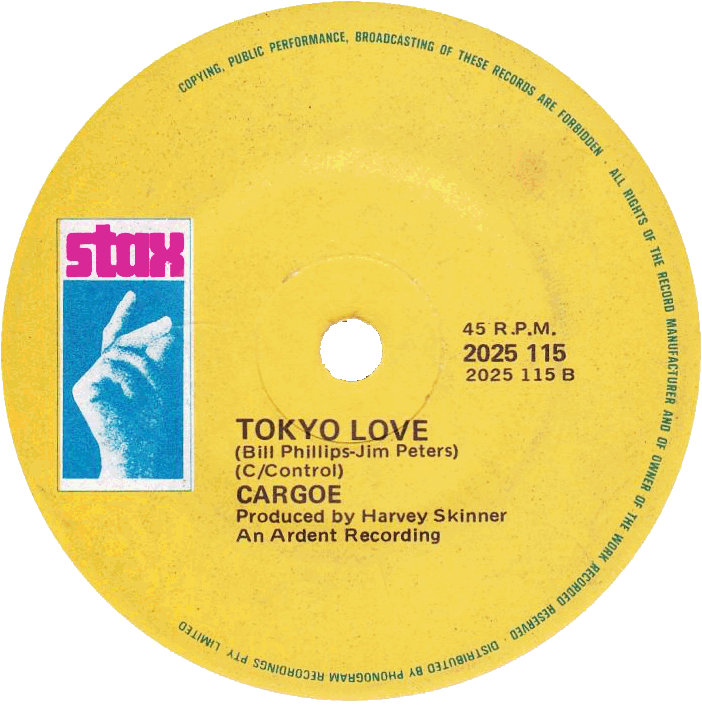
Like The Hot Dogs a year later, Cargoe released their sole record in the early 1970s on Memphis-based label Ardent Records, home to better-known Big Star. 


Indeed, Cargoe's self-titled record was released the very same year as Big Star's '#1 Record'. 

Produced by Terry Manning whose 'Home Sweet Home' Lp released in 1969 trod more or less the same musical ground, that is to say a blend of psychedelic pop rock and Memphis soul, with more folk-rock leanings on here, Cargoe's eponymous album can be regarded as a precursor of that now almost mythical Ardent sound which the aura of a band like Big Star has helped cultivate.

The band recorded their Album CARGOE with Terry Manning producing at, John Fry's Ardent Studios. They scored numerous Billboard and Cashbox Top 100 listings, and reviews from 1970 through 1973, along with major radio play of their first single “Feel Alright” and follow-up “I Love You Anyway”. The band’s studio LP CARGOE was even featured, with Isaac Hayes Shaft, which won an Academy Award/Oscar that year for Best Original Song, in a Special Edition section of Billboard’s June 3, 1972 “The Deck is STAX” promotion.

The band began a west coast tour the summer of 1972, but was caught up in the distribution and bankruptcy label problems at Stax/Volt, who distributed the album and owned the masters. Distribution was sold to Columbia Records who failed to include Cargoe in their catalog, which meant that listeners who heard the hit couldn't actually buy the record. “Feel Alright” and their debut CARGOE LP fell off the charts instantly.

The same label troubles caused both Cargoe and Big Star to disband within a short time. Big Star went on to become one of the most beloved and influential bands of the entire decade, while Cargoe pretty much disappeared out of the popular memory.

Ardent Records contracts for distribution with Stax/Volt gave Stax ownership of the master tapes. When Stax went bankrupt in the mid-'70s, ownership of the masters eventually wound up in the hands of Fantasy Records Saul Zaentz, and no one's been able to get the tapes for domestic release.

It's certainly worth noting that after nearly 40 years of producing and engineering countless hit records including ZZ Top, Led Zeppelin, George Thorogood, Celine Dion, Björk, Lenny Kravitz, Mariah Carey, Shania Twain, and many others, Terry Manning to this day regards Cargoe as “the great record he helped make that no one ever discovered”.. 

Bill Phillips - Hammond B3, Rhodes, Grand Piano, Vocals
Tommy Richard - Guitar, Vocals
Max Wisley - Bass, Vocals
Tim Benton - Drums, Vocals

01. Come Down  03:58
02. Feel Alright  02:33
03. Horses and Silver Things  03:49
04. Scenes  03:46
05. Things We Dream Today  02:44
06. Time  04:09
07. Feelin' Mighty Poorly  05:35
08. Thousand Peoples Song 4:12
09. Heal Me  03:11
10. I Love You Anyway  04:02
11. Leave Today  05:14

Bonus Track
12. Tokyo Love  03:51

1. Cargoe 1972
or
2. Cargoe 1972
or
3. Cargoe 1972