Followers

Saturday, October 22, 2022

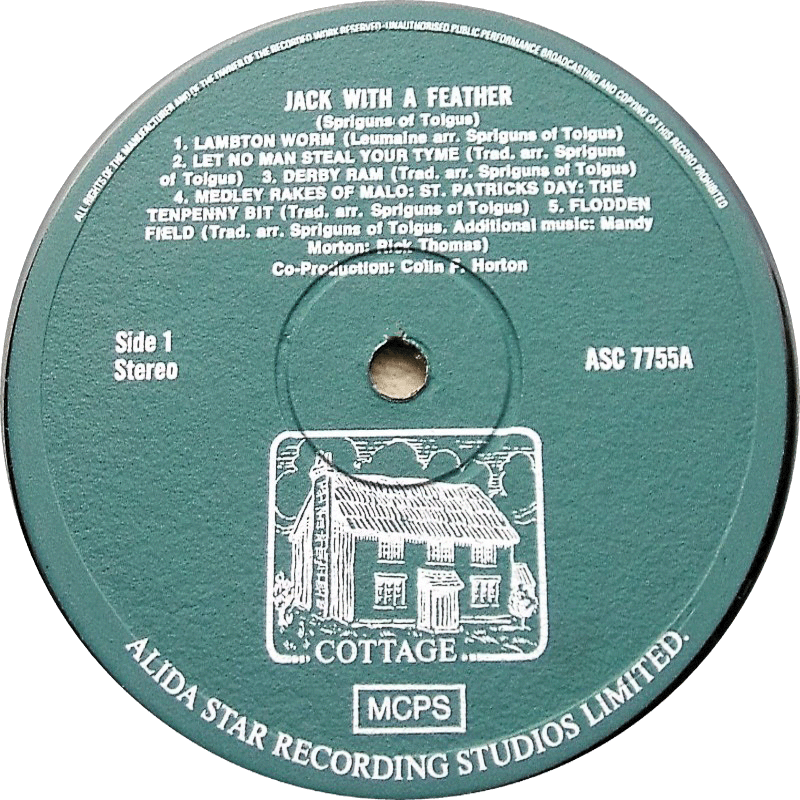
Spriguns of Tolgus - Jack With a Feather + 1 Unreleased Bonus Album 1974 (Folk UK 1975)


Former folk star Mandy Morton has gathered all of her music from her lead singer days with Cambridge band Spriguns of Tolgus and her later solo career into one six-album box set and discovered it reveals the story of her life.

After running away to Cambridge in the Sixties at the age of just 15, Mandy Morton stepped into a world of flower power and music that led her into a glittering decade as a folk artist.

Leaving behind her rowing parents, she came to live with her older sister in the city and soon found everyone had a guitar and was joining a band.

When she and her husband at the time, Mike, started a regular folk night at The Anchor pub, their band Spriguns of Tolgus was talent spotted and it led to a 10-year recording career. But Mandy later left it all behind to become a journalist and novelist.

Now those albums have been repackaged as a retrospective CD box set called After The Storm, that features the band’s albums plus previously unreleased material and a DVD of a live performance from 1979. After many years not even listening to her own songs, she is finally ready to talk about those heady days.

Mandy says: “I did run away in 1968 when I was just 15, which was a bit naughty. But my parents argued a lot and my childhood was quite unhappy. My father had been a fighter pilot in the Second World War and was highly decorated by the king. But of course when all the men came home, it was not a home for heroes. So he’d sort of changed who he was and my mother, who had married a gallant fighter pilot, ended up with a bit of a shambles of a marriage, so the two of them kept the war going between them, to put it mildly.


“Consequently, all three of us children got out as soon as we could. And luckily my sister had married an undergraduate by 1968 and was living in Cambridge. So it was an obvious place to run to because my sister always tended to look after me when I was younger. She sent a van with some friends who had a band to Nottingham. We loaded up anything that was precious to me and that began my life in Cambridge.”

Mandy described the part of Cambridge she arrived in as “bedsitter-land” and as soon as she reached 18, she moved into her own bedsit.

“It was a wonderful time. The Folk Festival had been going for a few years, so there was a big folk scene. There were gigs everywhere in pubs, at the university and the Corn Exchange. And of course, Cambridge was full of hippies. It was a time when people walked the streets without shoes on, wearing kaftans and beads. The economy was bad but we were young and we had our lives ahead of us so we didn’t care much about that.”

By day, she was running a fashion store called Pussycat Boutique on Petty Cury, but evenings were given over to music.

“Boutiques were all the rage in the late 60s, bringing fashion from swinging London - we were the first shop in the city to stock hot pants,” recalls Mandy.

“It was owned by a lovely lady called Mrs Atkins who roamed around doing all the buying, bringing in gear from London, and left it to my sister and I to actually run the day-to-day business there.”

During this time, Mandy met and married Mike Morton and together they launched the band Spriguns of Tolgus in 1972. It was named after a Cornish piskie and the location of a tin mine in a village close to where they went on holiday. They became big names on Cambridge’s music scene and before long were spotted by a talent scout.

“Ted, the landlord of The Anchor pub on Silver Street asked if we would run a music club to entice more of the students into his bar on Fridays,” says Mandy.

“We had no idea about running a club but started up by playing covers of Steeleye Span and Fairport Convention and from the audience eventually came the rest of the band.”

The Mortons, with Mandy on vocals and Mike on bass, were joined by Rick Thomas (fiddle) and Chris Russon (electric guitar). They would take the lyrics of traditional folk ballads and Mandy wrote music to accompany them. Particularly popular were the “bawdy ballads”, very rude traditional songs that make her blush to remember them now.

“When the record company approached me to say shall we do a complete collection of your music rather than just a couple of re-releases, they were very keen to include a cassette called Rowdy, Dowdy Day that we had recorded with a couple of other members of the band in our kitchen in Cross Street in Cambridge, using a dilapidated tape recorder,” says Mandy.

“I listened back to it and realised how thoroughly and disgustingly rude virtually every song was! It really is quite something that we got away with it - the sexual content was quite alarming. My blood started to boil and I thought, oh my God! We can’t unleash these things. But the record company said no, that’s the point. We are trying to show a history of how your music has developed. So I agreed.”

After they made that cassette, the band came to the attention of a recording studio in Leicestershire, which recorded their first vinyl album, Jack with a Feather. It was this album that got them noticed by Decca, who signed them up in 1976 and shortened their name to Spriguns.

Mandy says: “That’s when I started writing my own lyrics and, looking back, they were influenced by what had gone on in my life. Back in the 70s, we didn’t know much about mental health or that some things that had happened in our childhoods had damaged us beyond all measure.


“I wasn’t abused sexually and there was no violence towards us children. It was simply that my parents were unliveable with. It was their war that we didn’t want to be part of. It literally was mental torture. I was astonished to see people discussing all kinds of nonsense about my background and theories about the meaning of my lyrics on YouTube and I want to set the record straight.

“As a child, the reason that I started collecting dolls house pieces, and I went into my own little world and had conversations with myself because I wasn’t allowed to have friends. I mean, my parents didn’t believe in that. I did have quite a lonely childhood. So I made up my own stories.

“People say that if something terrible has happened you should write it down and throw it on a fire, because you feel better afterwards. And I guess that’s exactly what I did with all my song-writing, because when I look back on it now, 40 years later, and I listened to some of those lyrics it really does put me on edge. I can see what I was saying. It was fantastic to be able to write these things down and then go to perform them to lots of people who became fans and appreciated what you were doing.”

Spriguns brought out two albums with Decca (Revel, Weird & Wild, and Time Will Pass) and then when their deal ended they launched their own record label.

These next album, Magic Lady, which had an original print run in the hundreds, is now hugely collectible and sells for large sums of money.

As the UK folk music trend began to wane and punk exploded onto the scene, Mandy and Spriguns were wondering if they had reached a natural end point.

Rowdy Dowdy Way Studio Album, Private on Cassette released in 1974

She says: “I was thinking of throwing the towel in for a few years, because new wave and punk had sort of set fire to the country and bands like us that had a pride in what we did and created proper stage shows just weren’t needed anymore.

“The university circuit collapsed. People stopped having gigs in all the halls up and down the country where we used to make a living. And we had to think seriously about what we were going to do, whether we were going to scrap the band and get proper jobs, as my mother used to say, or alternatively, to forge new areas. And luckily we discovered after we’d been offered a residency in Oslo for the summer in 78 that there was a whole new world for us in Scandinavia.

“They were about three or four years behind the music scene in England. Therefore, they were still enjoying the hippie and progressive folk rock music, and so we toured Norway, Denmark and in Sweden. It felt like a rebirth of the band, rather than us sort of falling down like an awful lot of the bands did in this country.

“We had winter tours where we crossed the Arctic Circle and summers at amazing festivals. It was just the most wonderful experience and the penny dropped that we could make a living and we could continue with the band for a little bit longer. Scandinavia was beautiful and welcoming. The scenery we used to fly past in our little old van that climbed up the mountains and down the other side, was stunning.”

It was there in 1979 that Mandy signed a deal with Polydor Scandinavia, where she gained quite a following and produced the album Sea Of Storms. But around that time her marriage to Mike was coming to an end. He returned to Cambridge, where he died unexpectedly in his forties on November 27, 1995, after a short illness.

Mandy has spent the past couple of years going through all their old music and notes and materials to create the box set and it has brought back a lot of memories for her.

“I had the most wonderful lockdown just reliving all my own past history,” she says.


“And following my story from this distance was a revelation because as an older woman you have a completely different attitude to those days than you did when you were actually living through them. Because living through it was full of anxiety. Now I can look back and say, look at least I survived.

“The hardest part has been looking back on anything to do with Mike because we were very, very happy and we forged the band together and we grew up together. We were married very early. I was 18 when we got married and our marriage lasted 10 years with the band. Then we grew up and we realised that both of us wanted other things in our lives and we remained friends right up until his death.

“So, that was a very, very sad thing for me. And it was lovely doing this project because it was sort of like having him alive again in all the music I was listening to, all the photographs that I was looking at, and reliving that time and realising what a very special time it was. And of course the box set is dedicated to him because the band was a team. It wasn't just me, it was him and me. When Mike left the band after the marriage broke up, it just didn’t feel the same anymore. It had been a magical concoction. Without one or the other, it never could have happened.

“I used to get up and write songs in the middle of the night. And then I used to wake Mike up at four o'clock in the morning and say I’ve got one and he’d crawl out of bed and he’d get his bass guitar out and he’d listen to the new song. And by five o’clock in the morning, we had an arrangement ready to present to the band.

“I wrote songs and he ran the business and it was a marriage literally made in heaven. It was a good relationship. We managed to sort of get through the storm of the 70s, which wasn’t an easy time, and then by the 80s there were new things to think about. And Mike was a very good teacher. Eventually he was persuaded into going back into teaching and he ran the St Andrew’s tutorial centre for many years.

“I was very much married to the band while I knew that Mike wanted to have a family. He went on to do that and I’m very pleased that that’s what he did, because it never really fazed me. I had enough trouble being a child. I certainly didn’t want to create any more in this life. I wanted to keep my independence and I always wanted to plough my own furrow without having that sort of family concern around me. I don’t think that would have suited me in any way at all and I’ve never regretted it.”

The opportunity to bring all the music together in one box set presented itself when Mandy was approached by Cherry Red Records to write liner notes for a re-release of the Decca albums.

She says: “They came back and asked me if I wanted to release the other albums, and I thought, yes I would like to see them released again, especially Sea of Storms, which had been brought out by Polydor Norway and which I owned. I was also sick of seeing my work being bootlegged or going for silly prices - I thought this box set would stop all that. It was a wonderful opportunity that they offered me, so I grasped it with both paws.”

Since her stint as a folk star, Mandy has been an arts presenter on BBC Radio Cambridgeshire and most recently has been writing a series of detective novels with cats in the lead roles called The No 2 Feline Detective Agency.


Mandy says: “One day I was writing my own songs and recording albums. The next day, I was writing about somebody else doing the same thing. So it was a natural transition. And then after leaving the BBC and sort of continuing to make programs now and again, I actually got so bored that I felt that I needed to get into something else. So that's when the book started. Of course my own music career creeps in occasionally because one of my main characters in the books had a music career.”

Mandy now splits her time between Cambridge and Cornwall where she and her partner, crime writer Nicola Upson, pen their novels.

Bass – Mike Morton
 Guitar, Acoustic Guitar, Mandolin – Chris Russon
 Producer – Mike Morton
 Vocals, Acoustic Guitar [12-string], Dulcimer, Bongos – Mandy Morton
 Vocals, Acoustic Guitar, Mandolin, Fiddle, Dulcimer – Rick Thomas

01. Lambton Worm (Traditional) (04:06)
02. Let No Man Steal Your Thyme (Traditional) (02:53)
03. Derby Ram (Traditional) (02:45)
04. Jigs - Rakes Of Malo/St. Patricks Day/Ten Penny Bit (Traditional) (03:45)
05. Flodden Field (Traditional) (06:38)
06. Troopers Nag (Traditional) (03:36)
07. Curragh Of Kildare (Traditional) (04:44)
08. Keys Of Canterbury (Traditional) (03:31)
09. Twa Magicians (Traditional) (03:59)
10. Seamus The Showman (Tim Hart) (02:44)
11. Barren Banks Of Aden (Traditional) (01:13)

Bonus: Rowdy Dowdy Way Studio Album, Private on Cassette released in 1974
Amanda Morton / 12-string guitar, dulcimer & vocals
Mike Morton / bass guitar
Rick Thomas / guitars, mandolin, violin, pipe & vocals
Chris Russon / lead guitar & mandolin

12. Let No Man Steal Your Thyme (02:39)
13. The Jolly Tinker (02:11)
14. The Laily Worm & The Mackerel (02:11)
15. Spanish Ladies (01:56)
16. Matty Groves (07:15)
17. The Trees They Do Grow High (03:05)
18. Three Drunken Maidens (02:40)
19. Scotia Reel (02:08)
20. Keys Of Canterbury (02:59)
21. Sir Brian Botany (02:53)
22. Troopers Nag (03:26)
23. Cuckoos Nest (02:25)

1:  Tolgus
or
2: Tolgus
or
3: Tolgus
or
4: Tolgus


Friday, October 07, 2022

Magi - Win or Lose (Drug-Orientated High Energy Rock US 1976)


Size: 80.7 MB
Bitrate: 256
mp3
Ripped By: ChrisGoesRock
Artwork Included

Drug-orientated high energy rock, featuring some excellent guitar work but lacking variety of material. The band recorded at Uncle Dirty's Sound Machine in Kalamazoo, Michigan, but the label was based in Milford, Indiana, which may well have been their home. 

"This north Indiana outfit ruled the roost in the 'Michiana' region in the mid-'70s, attracting huge crowds whenever they played live. Often compared with Led Zeppelin, this 5-piece outfit rocked the area with a tight and raw sound that combined in-your-face hard rock with undisguised psychedelic tendencies and lashings of fuzz. 

It must be said the boys didn't do themselves any favours by issuing their only known album with a cover reminiscent of a Journey photo shoot, but regardless of their dubious hair and sense of dress, Magi certainly deserved more than the obscurity into which they ultimately lapsed. Win Or Lose, recorded at Uncle Dirty's Sound Machine studios in Michigan in 1976, and which boasts a series of solid songs propelled by a tight rhythm section and some more-than respectable vocals, is always reviewed enthusiastically." 

01. Win Or Lose  
02. Undecided Man  
03. I Didn’T Ask You  
04. Steves Jam  
05. Fryin’ Away Time  
06. Snow Bound  
07. Runnin’ Low  
08. Everytime I’M With You 

1. Magi
or
2. Magi
or
3. Magi


Saturday, September 24, 2022

dBpoweramp Music Converter 2022.09.02 Reference (The Latest Version)


Audio conversion perfected, effortlessly convert to mp3, FLAC, Apple lossless and more. dBpoweramp Music Converterâ„¢ has become the standard tool for audio conversions, over 30 million users world trust their converting to dBpoweramp.

mp3 Converter
Convert mp3, m4a (iTunes & iPod), WMA, WAV, AIFF, AAC, FLAC, Apple Lossless (ALAC) to name a few.

High Speed Conversions
Look for a mp3 converter which encodes using all CPU cores simultaneously, get the job done in double quick time.

No Malware
Free converters come with a little extra (a spying toolbar, Trojan, malware, or virus), dBpoweramp has never bundled in 15 years, those wanting an mp3 converter, get just that and only that. No Trojan, no malware, no viruses.

Batch Convert
Large numbers of files with 1 click, filter on mp3 or other file type.

DSP Effects
Process the audio with Volume Normalize, or Sample / Bit Rate Conversion. dBpoweramp is a fully featured mp3 Converter.

Simplicity
dBpoweramp integrates into Windows Explorer, an mp3 converter that is as simple as right clicking on the source file; Convert To. Popup info tips, Edit ID-Tags are all provided.

It is safe to say, no other audio program converts more multi-format audio files than dBpoweramp, we have spent 15 years perfecting format-compatibility and conversion stability. If converting FLAC to mp3, wma to mp3, or wav to mp3, dBpoweramp is the right choice.

1. dbPower
or
2. dbPower
or
3. dbPower

Friday, September 16, 2022

The Youngbloods - Selftitled (US Psychedelic Folk-Rock US 1967) + 2 Bonus Albums


The Youngbloods - Selftitled (US Psychedelic Folk-Rock US 1967) 

Size: 163 MB
Bit Rate: 256
mp3
Ripped by: ChrisGoesRock
Artwork Included
Source: Japan 24-Bit Remaster

The Youngbloods is an album by the American rock band The Youngbloods, released in 1967. It was also reissued in 1971 under the title Get Together after the popular single from the album. The album peaked at number 131 on the Billboard 200 although two years later the single "Get Together" reached number five and sold more than a million copies.

"Get Together" was written by Chet Powers (aka Dino Valenti of Quicksilver Messenger Service) and had already appeared in 1966 as a track on the first album by The Jefferson Airplane. Upon first release as a single by The Youngbloods in 1967, it only went to #62 in the pop charts. Two years later, after being featured in radio and television commercials, the track was re-released and climbed to number 5 in charts, selling more than a million records.


The first song on the album, "Grizzly Bear" (spelled "Grizzely Bear" on the album cover), was also released as a single reaching #52 in the pop charts in December 1966. Jerry Corbitt took credit for writing this song, but it had appeared on a 1928 recording by singer/songwriter Jim Jackson. The song featured the "jug band" style popularized by The Lovin' Spoonful, Jim Kweskin Jug Band and other similar groups of the middle 1960s. The title refers to a popular dance style of the 1910s. Corbitt also wrote the second song on the LP, the ballad "All Over the World (La La)". Side one also featured Blind Willie McTell's "Statesboro Blues" and another ballad, "One Note Man" written by fellow Cambridge folk musician Paul Arnoldi (spelled "Arnaldi" on the record label).


Side Two featured two more songs written by fellow folk singer-songwriters, Fred Neil's "The Other Side of This Life" and "Four in the Morning" by George "Robin" Remailly (who became a member of the Holy Modal Rounders in the 1970s).

Jesse Colin Young wrote two ballads on side two, "Tears Are Falling" and "Foolin' Around (The Waltz)" which alternates between 4/4 and 3/4 time signatures. Classical cello was added to "Foolin' Around" by George Ricci. Side two ends with two blues standards, Jimmy Reed's "Ain't That Lovin' You" and Mississippi John Hurt's "C.C. Rider". The last song featured a hard-rocking guitar jam that was common in the late 1960s, especially for San Francisco, which would soon become the Youngbloods' destination both geographically and musically.

The Youngbloods were an American rock band consisting of Jesse Colin Young (vocals, bass), Jerry Corbitt (gitar), Lowell Levinger, nicknamed "Banana" (guitar and electric piano), and Joe Bauer (drums). Despite receiving critical acclaim, they never achieved widespread popularity. Their only U.S. Top 40 entry was "Get Together".

Jesse Colin Young (born Perry Miller, November 22, 1941, Queens, New York City) was a moderately successful folk singer with two LPs under his belt – Soul of a City Boy (1964) and Youngblood (1965) – when he met fellow folk singer and former bluegrass musician from Cambridge, Jerry Corbitt (born Jerry Byron Corbitt, January 7, 1943, Tifton, Georgia). When in town, Young would drop in on Corbitt, and the two played together exchanging harmonies.

Beginning in January 1965, the two began performing on the Canadian circuit as a duo, eventually adopting the name "The Youngbloods". Young played bass, and Corbitt played piano, harmonica and lead guitar. Corbitt introduced Young to a bluegrass musician, Lowell Levinger (born Lowell Levinger III, 1946, Cambridge, Massachusetts). Levinger, known as "Banana", could play the piano, banjo, mandolin, mandola, guitar and bass; he had played in the Proper Bostonians and the Trolls, and played mainly piano and guitar in the Youngbloods. He knew of a fellow tenant who could flesh out the band, Joe Bauer (born September 26, 1941, Memphis, Tennessee), an aspiring jazz drummer with experience playing in society dance bands.

Once the line-up was set, Jesse Colin Young and the Youngbloods, as the group was then known, began building a reputation from their club dates. (Early demo sides from 1965 were later issued by Mercury Records on the Two Trips album.) Their first concert had been at Gerde's Folk City in Greenwich Village; months later, they were the house band at the Cafe Au Go Go and had signed a recording contract with RCA Records. Young, however, was not satisfied with RCA. "Nobody at [RCA] was really mean or anything; everybody was just kind of stupid," he explained to Rolling Stone magazine. "They never knew what to make of us, and tried to set us up as a bubblegum act... they never knew what we were, and never knew how to merchandise us."

The arrangement did produce one charting single in "Grizzly Bear" (#52, 1967). Several critically praised albums followed: The Youngbloods (1967, later retitled Get Together); Earth Music (1967); and Elephant Mountain (1969), with its track, "Darkness, Darkness".

In 1967, when "Get Together", a paean to universal brotherhood, first appeared, it did not sell very well, reaching only No. 62 on the chart. But two years later – after Dan Ingram had recorded a brotherhood promotion for WABC-AM in which the song was used as a bed for the promotion, and after the National Council of Christians and Jews subsequently used the song as their theme song on television and radio commercials – the track was re-released and cracked the Top 5. This disc sold over one million copies, and received a gold record, awarded by the R.I.A.A. on 7 October 1969.

Johnny Carson once reportedly refused to allow the band to perform on The Tonight Show Starring Johnny Carson, saying they were overly demanding during the pre-show soundcheck. In a 2009 interview, Young stated that the band refused to perform because the show reneged on a promise that they would be allowed to play a song from their new album Elephant Mountain, instead demanding that they only play "Get Together".

With Corbitt's departure from the band (for a solo career) in 1969, before the band recorded the Elephant Mountain album, Levinger assumed lead guitar duties and played extensively on Wurlitzer electric piano. The band became adept at lengthy improvisations in their live performances (as captured on the albums Rock Festival and Ride the Wind released after the band moved over to their own Warner Brothers distributed Raccoon label).


In 1971 the group added bassist Michael Kane to their line-up and put out two more albums Good & Dusty (1971), which featured an answer to Merle Haggard's Okie from Muskogee, "Hippie from Olema", and High on a Ridgetop (1972) before disbanding. Young, Levinger and Bauer all went on to solo careers, of which only Young had any notable success. Levinger, Bauer and Kane were part of another group, Noggins, in 1972 that only lasted for one album, Crab Tunes. Bauer died of a brain tumor in September 1982, at the age of 40.

In 1971 Jerry Corbitt and former Youngbloods producer Charlie Daniels formed a band called Corbitt & Daniels and toured.

In 1976 HT Rabin, drummer from Alias, joined the Youngbloods for a brief tour.

Banana supplied guitar, banjo, synthesizer, and back-up vocals to Mimi Fariña's 1985 solo album, Solo, and also toured with her on and off from 1973 until the 1990s. During the 1980s and 1990s, he played with the jam rock band Zero on keyboards, vocals and rhythm guitar.

In late 1984, The Youngbloods briefly reunited for a club tour. The 1984 line-up contained Young, Corbitt and Levinger, plus new members David Perper (drums, ex-Pablo Cruise) and Scott Lawrence (keyboards, woodwinds). Once the tour was completed, the group disbanded once again by mid-1985.

Following the September 11 terrorist attacks, the media conglomerate Clear Channel Communications included The Youngbloods' recording of "Get Together" on a list of "lyrically questionable" songs that was sent to its 1,200 radio stations in the United States.

Jerry Corbitt died of lung cancer on March 8, 2014. He was 71.

Personnel
✪ Jesse Colin Young – bass, lead vocals, rhythm guitar
✪ Jerry Corbitt – rhythm guitar, backing vocals
✪ Lowell "Banana" Levinger – lead guitar, electric piano
✪ Joe Bauer – drums, percussion

Original Album Mono Version:
01. Grizzly Bear 02:23
02. All Over The World (La-La) 03:18
03. Statesboro Blues 02:22
04. Get Together 04:41
05. One Note Man 02:27
06. The Other Side Of This Life 02:31
07. Tears Are Falling 02:29
08. Four In The Morning 02:55
09. Foolin' Around (The Waltz) 02:56
10. Ain't That Lovin' You, Baby 02:47
11. C. C. Rider 02:41

Original Album Stereo Version:
12. Grizzly Bear 02:23
13. All Over The World (La-La) 03:16
14. Statesboro Blues 02:20
15. Get Together 04:39
16. One Note Man 02:26
17. The Other Side Of This Life 02:30
18. Tears Are Falling 02:28
19. Four In The Morning 02:53
20. Foolin' Around (The Waltz) 02:52
21. Ain't That Lovin' You, Baby 02:41
22. C. C. Rider 02:40

Bonus tracks
23. Get Together (Promotional Single Version) 03:27
24. Merry-Go-Round 02:13
25. Se Qualcuno Mi Dira (Get Together Italian Version) 03:47
26. Qui Con Noi, Tra Di Noi (Grizzly Bear Italian Version) 02:20


The Youngbloods - The Avalon Ballroom 1969 (Bootleg)

Size: 124 MB
Bitrate: 320
mp3
Found in OuterSpace
No Artwork

The Youngbloods was an American folk rock band consisting of Jesse Colin Young (vocals, bass), Jerry Corbitt (guitar), Lowell Levinger, nicknamed "Banana," (guitar and electric piano), and Joe Bauer (drums). Despite receiving critical acclaim, they never achieved widespread popularity. Their only U.S. Top 40 entry was "Get Together".

Jesse Colin Young (b. Perry Miller, November 11, 1941, Queens, New York City) was a moderately successful folk singer with two LPs under his belt – Soul of a City Boy (1964) and Youngblood (1965) – when he met fellow folk singer and former bluegrass musician from Cambridge, Jerry Corbitt (b. Tifton, Georgia). When in town, Young would drop in on Corbitt, and the two played together exchanging harmonies.

Beginning in January 1965, the two began performing on the Canadian circuit as a duo, eventually adopting the name "The Youngbloods". Young played bass, and Corbitt played piano, harmonica and lead guitar. Corbitt introduced Young to a bluegrass musician, Lowell Levinger (b. Lowell Levinger III, 1946, Cambridge, Massachusetts). Levinger, known as "Banana", could play the piano, banjo, mandolin, mandola, guitar and bass; he had played in the Proper Bostoners and the Trolls, and played mainly piano and guitar in the Youngbloods. He knew of a fellow tenant who could flesh out the band, Joe Bauer (b. September 26, 1941, Memphis, Tennessee), an aspiring jazz drummer with experience playing in society dance bands.

Once the lineup was set, Jesse Colin Young and the Youngbloods, as the group was then known, began building a reputation from their club dates. (Early demo sides from 1965 were later issued by Mercury Records on the Two Trips album.) Their first concert had been at Gerde's Folk City in Greenwich Village; months later, they were the house band at the Cafe Au Go Go and had signed a recording contract with RCA Records. Young, however, was not satisfied with RCA. "Nobody at [RCA] was really mean or anything; everybody was just kind of stupid," he explained to Rolling Stone magazine. "They never knew what to make of us, and tried to set us up as a bubblegum act... they never knew what we were, and never knew how to merchandise us."


The arrangement did produce one charting single in "Grizzly Bear" (#52, 1967). Several critically praised albums followed: The Youngbloods (1967, later retitled Get Together); Earth Music (1967); and Elephant Mountain (1969), with its track, "Darkness, Darkness".

In 1967, when "Get Together", a paean to universal brotherhood first appeared, it did not sell very well, reaching only No. 62 on the chart. But two years later – after Dan Ingram had recorded a brotherhood promotion for WABC-AM in which the song was used as a bed for the promotion, and after the National Council of Christians and Jews subsequently used the song as their theme song on television and radio commercials – the track was re-released and cracked the Top 5. This disc sold over one million copies, and received a gold record, awarded by the R.I.A.A. on 7 October 1969.

Johnny Carson once reportedly refused to allow the band to perform on The Tonight Show Starring Johnny Carson, saying they were overly demanding during the pre-show soundcheck. In a 2009 interview, Young stated that the band refused to perform because the show reneged on a promise that they would be allowed to play a song from their new album Elephant Mountain, instead demanding that they only play "Get Together".

With Corbitt's departure from the band (for a solo career) in 1969, before the band recorded the Elephant Mountain album, Levinger assumed lead guitar duties and played extensively on Wurlitzer electric piano. The band became adept at lengthy improvisations in their live performances (as captured on the albums Rock Festival and Ride the Wind released after the band moved over to their own Warner Brothers distributed Raccoon label).

In 1971 the group added bassist Michael Kane to their lineup and put out two more albums Good & Dusty (1971), which featured an answer to Merle Haggard's Okie from Muskogee, "Hippie from Olema", and High on a Ridgetop (1972) before disbanding. Young, Levinger and Bauer all went on to solo careers, of which only Young had any notable success. Levinger, Bauer and Kane were part of another group, Noggins, in 1972 that only lasted for one album, Crab Tunes. Bauer died of a brain tumor in September 1982, at the age of 40.

In 1971 Jerry Corbitt and former Youngbloods producer Charlie Daniels formed a band called Corbitt & Daniels and toured.

In 1976 HT Rabin, drummer from Alias, joined the Youngbloods for a brief tour.

Banana supplied guitar, banjo, synthesizer, and back-up vocals to Mimi Fariña's 1985 solo album, Solo, and also toured with her on and off from 1973 until the nineties. The Richard & Mimi Fariña Fan Site

In late 1984 The Youngbloods briefly reunited for a club tour. The 1984 lineup contained Young, Corbitt and Levinger, plus new members David Perper (drums, ex-Pablo Cruise) and Scott Lawrence (keyboards, woodwinds). Once the tour was completed, the group disbanded once again by early 1985.

Following the September 11 terrorist attacks, the media conglomerate Clear Channel Communications included The Youngbloods' recording of "Get Together" on a list of "lyrically questionable" songs that was sent to its 1,200 radio stations in the United States.

The Youngbloods
March 30, 1969
The Avalon Ballroom, San Francisco, CA.
FM Radio

This short set by the Youngbloods was FM broadcast on KPFA 

01. Ride the Wind
02. Sugar Babe
03. Four in the Morning
04. Too much monkey Business
05. Banana's 
06. Dolphins
07. The Wine Song
08. Darkness, Darkness
09. Beautiful


The Youngbloods - Beautiful, Live at San Francisco US 1971

Size: 97 MB
Bitrate: 256
mp3
Ripped By: ChrisGoesRock
Artwork Included

BEAUTIFUL! LIVE IN SAN FRANCISCO, 1971 By the time the Youngbloods, always crowd faves at the west coast ballrooms, performed live for San Francisco’s free-form radio pioneer KSAN in 1971, they’d honed their set to a fine gloss. 


Featuring the smooth as apple-butter voice of Jesse Colin Young and the guitar/keyboard wizardry of Banana, backed by the rock-solid bass-and-drum tandem of Michael Kane and Joe Bauer, the Youngbloods positively sparkle here. We’re elated to present a lengthy, previously unissued 13-song set that’s equal parts rocking R&B, dreamy jazzers and honky tonk flag-wavers, with just a little bit of psychedelic weirdness—topped off, of course, by a knockout version of their generational anthem, "Get Together." 

The Youngbloods: at the top of their game, making it all look so easy—and so damn beautiful.

01. Six Days On The Road  03.45        
02. Country Home  03.56          
03. On Sir Francis Drake  02.46        
04. Dreamboat  03.24        
05. Drifting and Drifting 06.23        
06. Interlude  02.23        
07. Old Dan Tucker  01.59        
08. You Can´t Catch Me - 04.15        
09. On A Beautiful Lake Spenard - 04.52       
10. Josianne - 07.13        
11. Explosion - 00.29        
12. Beautiful - 05.52 
13. Get Together - 04.07 


Part 1: Young
Part 2: Young
Part 3: Young
or
Part 1: Young
Part 2: Young
Part 3: Young
or
Part 1: Young
Part 2: Young
Part 3: Young


Thursday, September 08, 2022

Ted Nugent's Amboy Dukes - Tooth, Fang and Claw (US 1974)


Size: 97.3 MB
Bitrate: 320
mp3
Ripped by: ChrisGoesRock
Artwork Included

Tooth, Fang & Claw is the seventh and final album by Ted Nugent and The Amboy Dukes. It is the second offering on the DiscReet label. Re-issued in 1977 by Warner Bros as part of "Two Originals of... Ted Nugent".

The band consists of Nugent, Rob Grange on bass and drummer Vic Mastrianni. The album has the feel of the outdoors (esp. "Hibernation") and Nugent's love for hunting and rock and roll; the back sleeve pictures him playing hard in front of an amplifier stack, next to a wild boar trophy.


Like on the Amboy Dukes' previous three albums, the credits are followed by a short tongue-in-cheek statement. This time, "Fear not the crusted warblers, but be wary of the Mad Cheese Grater for he shall slaw the features from your face. Beware the public carnivores as they inevitably edibly have a soft nosed hollow point magnum behind every bush."

"Great White Buffalo" is one of the mainstays of Nugent's catalog and was generated on this album. In an interview with Classic Rock Revisited he discusses how he and Grange developed the song idea: "This was yet another magical moment like the original musical burst of so many of my songs. This amazing lick/song erupted spontaneously during a recording session around 1972-73," Nugent says. 


"As I was tuning up my Blonde Byrdland, that pattern leaped forth with a force to reckon with. Killer bass player, Rob Grange, stopped me and asked what the hell that was, and I said "I don't know, just jackin’ around, tuning up." He told me to play it again, but I failed to play the lick the same as I had just done moments before and he kept badgering me to re-discover the lick. I didn't. But after recording some other songs, I again went to tune up my Gibson and the lick burst forth again. 

Rob Grange yelled 'That's it! That's it!' So I played it a few times, showed the guys where I wanted to stop and start it up again, turned on the tape machine and recorded it in one fell swoop, making up the lyrics as I went along, articulating to the best of my ability my take on the great Indian legend of the spiritual beast of yore. Rob Grange came up with that wonderful fluid bass melody at the end, Vic the thundering double bass drum assault, and history was made. To this day it is one of my and the audiences' and band's all time favorites."


Also featured, a frantic and happily deranged version of "Maybellene", a 1955 classic of Chuck Berry (often quoted by Nugent in the late 70s as a major influence on his playing). Ted Nugent is credited for a one-finger guitar solo under the moniker "Rev Atrocious Theodosius".

The album includes one of very few "calm" Nugent songs of this era, "Sasha", which Nugent dedicated to his newly born daughter.


Due to Warner Bros distributing the album worldwide, Ted Nugent's music eventually began to reach overseas markets, but his royalties were not up to his expectations - DiscReet's manager & owner Frank Zappa reported mediocre sales. In late October 1974, rhythm guitarist Derek St. Holmes joined the band at least for one of the Amboy Dukes' final shows at Northeastern Illinois University in Chicago.

By 1975, Nugent abandoned the troubled DiscReet label and signed with Epic Records. He teamed with producer Tom Werman and Aerosmith’s managers, Leber-Krebs, who organized his live tours into commercially successful operations. The only Amboy Dukes member who continued with Nugent in his solo career is bassist Rob Grange. Nugent's band also included Derek St. Holmes on vocals and guitar, and drummer Clifford Davies; Ted Nugent moved forward to national and worldwide success.

In the 1993 film Dazed and Confused, the character Wooderson, played by Matthew McConaughey, wears a t-shirt featuring the Tooth Fang & Claw album cover.

In 1995, "Tooth, Fang & Claw" was a song on the album Spirit of the Wild, which marked Ted Nugent's return to an outdoor lifestyle and his original sound of hard rock.

Personnel
Ted Nugent – Guitar, vocals, percussion
 Rob Grange – Bass, vocals, arrangements, composer
 Vic Mastrianni – Drums, percussion
 Andy Jezowski (and the Crusted Warblers) – Backing vocals

01. "Lady Luck" - 5:57
02. "Living in the Woods" - 3:54
03. "Hibernation" - 9:19
04. "Free Flight" - 4:03
05. "Maybellene" - (Chuck Berry, Russ Fratto, Alan Freed) - 3:28
06. "The Great White Buffalo" - 4:57
07. "Sasha" - 3:06
08. "No Holds Barred" - 4:48

1: Ted
or
2: Ted
or
3: Ted


Wednesday, September 07, 2022

Amon Dûûl - Paradieswärts Düül (Progressive Rock Germany 1970)


Size: 105 MB
BitRate: @320
mp3 
Ripped by: ChrisGoesRock
Artwork Included

Amon Duul could only have happened in a certain time and place. This is, of course, the only bona fide studio album released by Amon Duul, and I have to say it is an absolute gem. The Repertoire Records edition is superlative - the clarity and warmth of the sound is impeccable, and the two bonus tracks are not only brilliant in their own right, but actually improve the structure of the CD.

'Para Dieswarts Duul' does not need to be sliced into tracks. Even though there are actually plenty of small musical shifts within each song - washes of synthesiser, key changes, vocals floating in and out of harmonies - it doesn't seem so at all. It seems like it's all one song.- one constant, flowing synthesis of sparse and delicate guitar lines, with keyboards and vocals and flutes and bongos occasionally stepping into focus for a while before vanishing back into the central piece. These five songs knitted together as an album present a wonderfully seamless statement of intent, even if the tone of one piece clashes with another (for example, the opening odyssey 'Love Is Peace' is warm and dreamily fun, whereas the closing 'Paramechanical World' - a bonus track - is spare and mournful, even hopeless).


Unlike the other Amon Duul albums, which are all taken from the same monster jam session in 1969, it is unclear exactly how much of this is improvised. I suspect 'Snow Your Thirst...' is, as it ends with a hard cut, but the rest of the album is teetering gloriously between the composed and the telepathised. It rhythmically feels its way forward, rarely breaking the pulse through its entire duration.

And strangely, that's all I can remember about it. 'Para Dieswarts Duul' is the ultimate background music, and is as successful in sending me to sleep as it is in enthralling me, drawing me into the swaying rhythms and the wonderful kosmische sirenism vocals. It is a very special album indeed, comparable to much of the rest of the Krautrock cannon in the same way that 'Islands' compares to the rest of King Crimson's music: A beautiful oddity.

Clearly the best Amon Duul's album with the original line up. Always primitive kraut / folk improvisations but the emphasis is now put on more structured songs. The abusive, mucky jam attempts of the previous efforts let the place to an easy listening psychedelic folk "trip" and it works formidably. The music retains the listener's attention thanks to intriguing, emotional compositions. 

The first track starts with catchy, cool guitar melodies, acoustic percussions, with "pastoral", "peaceful" flute lines. A tremendous energy prevails. Lyrics are all about "peace and love"; "Love is peace and freedom is harmony" said the voice. The following track carries on the same beautiful, semi-acoustic psych atmosphere. It alternates experimental, improvised ideas to serene, inspired structured sections. This one is instrumental, rather "archaic" in sound but really efficient. The two bonus tracks are slow, floating, moody pieces with "stoned" melodic vocals. "Eternal Flow » is made of sad guitar arpeggios, a nice bluesy rock section with plaintive vocals, a mysterious, rather desperate atmosphere. "Paramechanical World » is a crying, lovely free ballad. Don't ask sophistication but just simplicity and feeling and you will definitely enjoy this album.

01. Love Is Peace (17:13)
02. Snow Your Thirst And Sun Your Open Mouth (9:28)
03. P Mechanische Welt (7:38)

Bonus Tracks: 
04. Eternal Flow (4:10)
05. Paramechanical World (5:44)

1: Amon
or
2: Amon
or
3: Amon


Sunday, August 14, 2022

Peacepipe - Peacepipe (Outstanding Heavy Psychedelia US 1970)


Size: 94.4 MB
Bit Rate: 256
mp3
Ripped by: ChrisGoesRock
Artwork Included

Peacepipe were the brainchild of guitarist John Uzonyi. They were a power trio that played Southern California and Arizona in the late '60s. They released a single during their existence, and also cut this album, which remained unreleased until the mid-'90s. 

Originally released on Rockadelic on vinyl only, Shadoks has now reissued it on compact disc, remastered from the original tapes. If you're into heavy psych guitar, you really need to hear this album.


Uzonyi has a monstrous tone on guitar, similar at times to Jimi Hendrix's feedback dive-bombing, but the two have very different playing styles.

Uzonyi is aided by drummer Gary Tsuruda and keyboard player Rick Abts, but the show belongs to Uzonyi. There are at least two guitars present most of the time, Uzonyi is the singer, and he most likely plays the bass tracks as well.

Uzonyi formed the band with Tsuruda in the mid-sixties whilst they were still at High School. In 1968 they headed for Hollywood and recorded two tracks; The Sun Won't Shine Forever and Lazy River Blues, which were released on a 45 by Accent. After school Uzonyi joined the U.S. Air Force and was based in Tucson, Arizona. 

There he met Rick Abts who joined Jon and Gary to form The Human Equation. They gigged around the U.S. West but disbanded in 1969 to pursue non-musical careers. Shortly after, though, they reformed to record the tunes, which 26 years later found their way onto a Rockadelic's Peacepipe album. (Jon shelved the project at the time).

Long awaited official reissue of this blistering late '60's US acid rock mind blower. Originally reissued on Rockadelic a few years back (one of the label's best known and rarest releases) here it is in digital glory with cool photos, detailed liner notes and bonus tracks. 

Stunning tripped out guitar based psych with ripping acid wah-wah lead guitars, distortion, swirling keyboards and stoned lyrics. Turn it up to 13 and trip out. Fantastic!

Line-up/Musicians
- John Uzonyi / Guitar, vocals
- Gary Tsuruda / Drums
- Rick Abts / Keyboards

01. Sea Of Nightmares (6:26) 
02. Angel Of Love (4:10) 
03. I Can Never Take Your Dreams Away (6:24) 
04. Carry On Together (2:43) 
05. Bikers Tune (2:49) 
06. Open Your Mind (4:50) 
07. Day The War Has Ended (10:08) 
08. Love Shines (3:12) 
09. Keep A Smilin' Cari (2:49) 
10. Sun Won't Shine Forever (2:49) 
11. Lazy River Blues (3:39)

1. Pipe
or
2. pipe
or
3. pipe

Friday, August 05, 2022

The 50 most valuable records of all time (So Far...)

Hello all music collectors. Summer is here and the rain is pouring down...

I am posting here below the most sought after records as they have sold for up to today from the website: "POPSIKE" Auction prices are from eBay.com.

Good to know: These auction prices do NOT tell you what the disc is worth, the price is more to know how rare it is (in different conditions) and how many people bid on the auction.

The value of an album: It's a pity for anyone who wants to start collecting original albums on vinyl today. Sellers at record fairs and websites ruin it for record collectors. 

I see many sellers who have an LP album that is EX-/M-, but still write the amount that is for records in the MINT GRADE. It is very rare for a record, single, EP and LP album to be in mint condition. A Mint album must be in an absolutely new condition. Both the vinyl and the cover must be in absolutely new condition. For example, if the album looks "Used", it falls to EX+ inexorably and thus the value of the album drops.

The discs in the list below are in different conditions and, as I said, do not tell what the disc is worth. It is enough for the buyers to know that the record is almost impossible to find. The person with the most money wins. 

//ChrisGoesRock


Tuesday, July 26, 2022

The Next Morning - Selftitled (Raw US Heavy 1971)


Size: 64.3 MB
Bitrate: 256
mp3
Ripped By: ChrisGoesRock
Artwork Included

A wickedly rare phase 'n' fuzz fueled slice of psychedelia circa 1970! - featuring ripsnorting guitar-work by Bert Bailey- these guys were Caribbean immigrants (four from Trindad, one from the Virgin Islands) and they idolized the Who and Jimi Hendrix.

African-American psychedelic groups, and rock bands from Trinidad, were both uncommon items around 1970. The Next Morning fit into both categories, making them an interesting curiosity regardless of their music. The music, however--average 1970 hard-rock with soul, hard rock, and psychedelic influences, particularly from Jimi Hendrix--is not as unusual as their origins. One would not suspect from listening that the group were largely from Trinidad, with the proliferation of heavy, bluesy guitar and organ riffs, and the strained soul-rock vocals of Lou Phillips. They recorded one album, released in 1971, that received little notice before their breakup. 


The Next Morning formed in the late 1960s in New York, four of the five members having come to the city from Trinidad; Lou Phillips was from the Virgin Islands. Jimi Hendrix was a big influence on the band, as were some other hard rock acts of the period like the Who, and rock-soul hybrids like Sly Stone and the Chamber Brothers. The Next Morning were busy on the New York club circuit and attracted attention from Columbia Records, but ended up signing to the smaller Roulette label, whose Calla subsidiary issued their lone, self-titled LP in 1971. Although the jagged guitar sounds of Bert Bailey and some unexpected chord shifts made the album less pedestrian than some efforts in the style, the songs tended toward the long and meandering side, and the material was not as outstanding as their influences. The Next Morning's career sputtered out in the early 1970s, with bassist Scipio Sargeant finding some work doing horn arrangements for Joe Tex and Harry Belafonte. The Next Morning album was reissued on CD by Sundazed in 1999. 

01. The Next Morning 4:57
02. Life 2:57
03. Changes Of The Mind 6:01
04. Life Is Love 5:34
05. Back To The Stone Age 5:26
06. Adelane 2:51
07. A Jam Of Love 4:24
08. Faces Are Smiling 6:29 

1. Next
or
2. Next
or
3. Next