Followers

Thursday, September 08, 2022

Ted Nugent's Amboy Dukes - Tooth, Fang and Claw (US 1974)


Size: 97.3 MB
Bitrate: 320
mp3
Ripped by: ChrisGoesRock
Artwork Included

Tooth, Fang & Claw is the seventh and final album by Ted Nugent and The Amboy Dukes. It is the second offering on the DiscReet label. Re-issued in 1977 by Warner Bros as part of "Two Originals of... Ted Nugent".

The band consists of Nugent, Rob Grange on bass and drummer Vic Mastrianni. The album has the feel of the outdoors (esp. "Hibernation") and Nugent's love for hunting and rock and roll; the back sleeve pictures him playing hard in front of an amplifier stack, next to a wild boar trophy.


Like on the Amboy Dukes' previous three albums, the credits are followed by a short tongue-in-cheek statement. This time, "Fear not the crusted warblers, but be wary of the Mad Cheese Grater for he shall slaw the features from your face. Beware the public carnivores as they inevitably edibly have a soft nosed hollow point magnum behind every bush."

"Great White Buffalo" is one of the mainstays of Nugent's catalog and was generated on this album. In an interview with Classic Rock Revisited he discusses how he and Grange developed the song idea: "This was yet another magical moment like the original musical burst of so many of my songs. This amazing lick/song erupted spontaneously during a recording session around 1972-73," Nugent says. 


"As I was tuning up my Blonde Byrdland, that pattern leaped forth with a force to reckon with. Killer bass player, Rob Grange, stopped me and asked what the hell that was, and I said "I don't know, just jackin’ around, tuning up." He told me to play it again, but I failed to play the lick the same as I had just done moments before and he kept badgering me to re-discover the lick. I didn't. But after recording some other songs, I again went to tune up my Gibson and the lick burst forth again. 

Rob Grange yelled 'That's it! That's it!' So I played it a few times, showed the guys where I wanted to stop and start it up again, turned on the tape machine and recorded it in one fell swoop, making up the lyrics as I went along, articulating to the best of my ability my take on the great Indian legend of the spiritual beast of yore. Rob Grange came up with that wonderful fluid bass melody at the end, Vic the thundering double bass drum assault, and history was made. To this day it is one of my and the audiences' and band's all time favorites."


Also featured, a frantic and happily deranged version of "Maybellene", a 1955 classic of Chuck Berry (often quoted by Nugent in the late 70s as a major influence on his playing). Ted Nugent is credited for a one-finger guitar solo under the moniker "Rev Atrocious Theodosius".

The album includes one of very few "calm" Nugent songs of this era, "Sasha", which Nugent dedicated to his newly born daughter.


Due to Warner Bros distributing the album worldwide, Ted Nugent's music eventually began to reach overseas markets, but his royalties were not up to his expectations - DiscReet's manager & owner Frank Zappa reported mediocre sales. In late October 1974, rhythm guitarist Derek St. Holmes joined the band at least for one of the Amboy Dukes' final shows at Northeastern Illinois University in Chicago.

By 1975, Nugent abandoned the troubled DiscReet label and signed with Epic Records. He teamed with producer Tom Werman and Aerosmith’s managers, Leber-Krebs, who organized his live tours into commercially successful operations. The only Amboy Dukes member who continued with Nugent in his solo career is bassist Rob Grange. Nugent's band also included Derek St. Holmes on vocals and guitar, and drummer Clifford Davies; Ted Nugent moved forward to national and worldwide success.

In the 1993 film Dazed and Confused, the character Wooderson, played by Matthew McConaughey, wears a t-shirt featuring the Tooth Fang & Claw album cover.

In 1995, "Tooth, Fang & Claw" was a song on the album Spirit of the Wild, which marked Ted Nugent's return to an outdoor lifestyle and his original sound of hard rock.

Personnel
♦ Ted Nugent – Guitar, vocals, percussion
♦ Rob Grange – Bass, vocals, arrangements, composer
♦ Vic Mastrianni – Drums, percussion
♦ Andy Jezowski (and the Crusted Warblers) – Backing vocals

01. "Lady Luck" - 5:57
02. "Living in the Woods" - 3:54
03. "Hibernation" - 9:19
04. "Free Flight" - 4:03
05. "Maybellene" - (Chuck Berry, Russ Fratto, Alan Freed) - 3:28
06. "The Great White Buffalo" - 4:57
07. "Sasha" - 3:06
08. "No Holds Barred" - 4:48

1: Ted
or
2: Ted
or
3: Ted


Wednesday, September 07, 2022

Amon Dûûl - Paradieswärts Düül (Progressive Rock Germany 1970)


Size: 105 MB
BitRate: @320
mp3 
Ripped by: ChrisGoesRock
Artwork Included

Amon Duul could only have happened in a certain time and place. This is, of course, the only bona fide studio album released by Amon Duul, and I have to say it is an absolute gem. The Repertoire Records edition is superlative - the clarity and warmth of the sound is impeccable, and the two bonus tracks are not only brilliant in their own right, but actually improve the structure of the CD.

'Para Dieswarts Duul' does not need to be sliced into tracks. Even though there are actually plenty of small musical shifts within each song - washes of synthesiser, key changes, vocals floating in and out of harmonies - it doesn't seem so at all. It seems like it's all one song.- one constant, flowing synthesis of sparse and delicate guitar lines, with keyboards and vocals and flutes and bongos occasionally stepping into focus for a while before vanishing back into the central piece. These five songs knitted together as an album present a wonderfully seamless statement of intent, even if the tone of one piece clashes with another (for example, the opening odyssey 'Love Is Peace' is warm and dreamily fun, whereas the closing 'Paramechanical World' - a bonus track - is spare and mournful, even hopeless).


Unlike the other Amon Duul albums, which are all taken from the same monster jam session in 1969, it is unclear exactly how much of this is improvised. I suspect 'Snow Your Thirst...' is, as it ends with a hard cut, but the rest of the album is teetering gloriously between the composed and the telepathised. It rhythmically feels its way forward, rarely breaking the pulse through its entire duration.

And strangely, that's all I can remember about it. 'Para Dieswarts Duul' is the ultimate background music, and is as successful in sending me to sleep as it is in enthralling me, drawing me into the swaying rhythms and the wonderful kosmische sirenism vocals. It is a very special album indeed, comparable to much of the rest of the Krautrock cannon in the same way that 'Islands' compares to the rest of King Crimson's music: A beautiful oddity.

Clearly the best Amon Duul's album with the original line up. Always primitive kraut / folk improvisations but the emphasis is now put on more structured songs. The abusive, mucky jam attempts of the previous efforts let the place to an easy listening psychedelic folk "trip" and it works formidably. The music retains the listener's attention thanks to intriguing, emotional compositions. 

The first track starts with catchy, cool guitar melodies, acoustic percussions, with "pastoral", "peaceful" flute lines. A tremendous energy prevails. Lyrics are all about "peace and love"; "Love is peace and freedom is harmony" said the voice. The following track carries on the same beautiful, semi-acoustic psych atmosphere. It alternates experimental, improvised ideas to serene, inspired structured sections. This one is instrumental, rather "archaic" in sound but really efficient. The two bonus tracks are slow, floating, moody pieces with "stoned" melodic vocals. "Eternal Flow » is made of sad guitar arpeggios, a nice bluesy rock section with plaintive vocals, a mysterious, rather desperate atmosphere. "Paramechanical World » is a crying, lovely free ballad. Don't ask sophistication but just simplicity and feeling and you will definitely enjoy this album.

01. Love Is Peace (17:13)
02. Snow Your Thirst And Sun Your Open Mouth (9:28)
03. P Mechanische Welt (7:38)

Bonus Tracks: 
04. Eternal Flow (4:10)
05. Paramechanical World (5:44)

1: Amon
or
2: Amon
or
3: Amon


Sunday, August 14, 2022

Peacepipe - Peacepipe (Outstanding Heavy Psychedelia US 1970)


Size: 94.4 MB
Bit Rate: 256
mp3
Ripped by: ChrisGoesRock
Artwork Included

Peacepipe were the brainchild of guitarist John Uzonyi. They were a power trio that played Southern California and Arizona in the late '60s. They released a single during their existence, and also cut this album, which remained unreleased until the mid-'90s. 

Originally released on Rockadelic on vinyl only, Shadoks has now reissued it on compact disc, remastered from the original tapes. If you're into heavy psych guitar, you really need to hear this album.


Uzonyi has a monstrous tone on guitar, similar at times to Jimi Hendrix's feedback dive-bombing, but the two have very different playing styles.

Uzonyi is aided by drummer Gary Tsuruda and keyboard player Rick Abts, but the show belongs to Uzonyi. There are at least two guitars present most of the time, Uzonyi is the singer, and he most likely plays the bass tracks as well.

Uzonyi formed the band with Tsuruda in the mid-sixties whilst they were still at High School. In 1968 they headed for Hollywood and recorded two tracks; The Sun Won't Shine Forever and Lazy River Blues, which were released on a 45 by Accent. After school Uzonyi joined the U.S. Air Force and was based in Tucson, Arizona. 

There he met Rick Abts who joined Jon and Gary to form The Human Equation. They gigged around the U.S. West but disbanded in 1969 to pursue non-musical careers. Shortly after, though, they reformed to record the tunes, which 26 years later found their way onto a Rockadelic's Peacepipe album. (Jon shelved the project at the time).

Long awaited official reissue of this blistering late '60's US acid rock mind blower. Originally reissued on Rockadelic a few years back (one of the label's best known and rarest releases) here it is in digital glory with cool photos, detailed liner notes and bonus tracks. 

Stunning tripped out guitar based psych with ripping acid wah-wah lead guitars, distortion, swirling keyboards and stoned lyrics. Turn it up to 13 and trip out. Fantastic!

Line-up/Musicians
- John Uzonyi / Guitar, vocals
- Gary Tsuruda / Drums
- Rick Abts / Keyboards

01. Sea Of Nightmares (6:26) 
02. Angel Of Love (4:10) 
03. I Can Never Take Your Dreams Away (6:24) 
04. Carry On Together (2:43) 
05. Bikers Tune (2:49) 
06. Open Your Mind (4:50) 
07. Day The War Has Ended (10:08) 
08. Love Shines (3:12) 
09. Keep A Smilin' Cari (2:49) 
10. Sun Won't Shine Forever (2:49) 
11. Lazy River Blues (3:39)

1. Pipe
or
2. pipe
or
3. pipe

Friday, August 05, 2022

The 50 most valuable records of all time (So Far...)

Hello all music collectors. Summer is here and the rain is pouring down...

I am posting here below the most sought after records as they have sold for up to today from the website: "POPSIKE" Auction prices are from eBay.com.

Good to know: These auction prices do NOT tell you what the disc is worth, the price is more to know how rare it is (in different conditions) and how many people bid on the auction.

The value of an album: It's a pity for anyone who wants to start collecting original albums on vinyl today. Sellers at record fairs and websites ruin it for record collectors. 

I see many sellers who have an LP album that is EX-/M-, but still write the amount that is for records in the MINT GRADE. It is very rare for a record, single, EP and LP album to be in mint condition. A Mint album must be in an absolutely new condition. Both the vinyl and the cover must be in absolutely new condition. For example, if the album looks "Used", it falls to EX+ inexorably and thus the value of the album drops.

The discs in the list below are in different conditions and, as I said, do not tell what the disc is worth. It is enough for the buyers to know that the record is almost impossible to find. The person with the most money wins. 

//ChrisGoesRock


Tuesday, July 26, 2022

The Next Morning - Selftitled (Raw US Heavy 1971)


Size: 64.3 MB
Bitrate: 256
mp3
Ripped By: ChrisGoesRock
Artwork Included

A wickedly rare phase 'n' fuzz fueled slice of psychedelia circa 1970! - featuring ripsnorting guitar-work by Bert Bailey- these guys were Caribbean immigrants (four from Trindad, one from the Virgin Islands) and they idolized the Who and Jimi Hendrix.

African-American psychedelic groups, and rock bands from Trinidad, were both uncommon items around 1970. The Next Morning fit into both categories, making them an interesting curiosity regardless of their music. The music, however--average 1970 hard-rock with soul, hard rock, and psychedelic influences, particularly from Jimi Hendrix--is not as unusual as their origins. One would not suspect from listening that the group were largely from Trinidad, with the proliferation of heavy, bluesy guitar and organ riffs, and the strained soul-rock vocals of Lou Phillips. They recorded one album, released in 1971, that received little notice before their breakup. 


The Next Morning formed in the late 1960s in New York, four of the five members having come to the city from Trinidad; Lou Phillips was from the Virgin Islands. Jimi Hendrix was a big influence on the band, as were some other hard rock acts of the period like the Who, and rock-soul hybrids like Sly Stone and the Chamber Brothers. The Next Morning were busy on the New York club circuit and attracted attention from Columbia Records, but ended up signing to the smaller Roulette label, whose Calla subsidiary issued their lone, self-titled LP in 1971. Although the jagged guitar sounds of Bert Bailey and some unexpected chord shifts made the album less pedestrian than some efforts in the style, the songs tended toward the long and meandering side, and the material was not as outstanding as their influences. The Next Morning's career sputtered out in the early 1970s, with bassist Scipio Sargeant finding some work doing horn arrangements for Joe Tex and Harry Belafonte. The Next Morning album was reissued on CD by Sundazed in 1999. 

01. The Next Morning 4:57
02. Life 2:57
03. Changes Of The Mind 6:01
04. Life Is Love 5:34
05. Back To The Stone Age 5:26
06. Adelane 2:51
07. A Jam Of Love 4:24
08. Faces Are Smiling 6:29 

1. Next
or
2. Next
or
3. Next


Wednesday, July 13, 2022

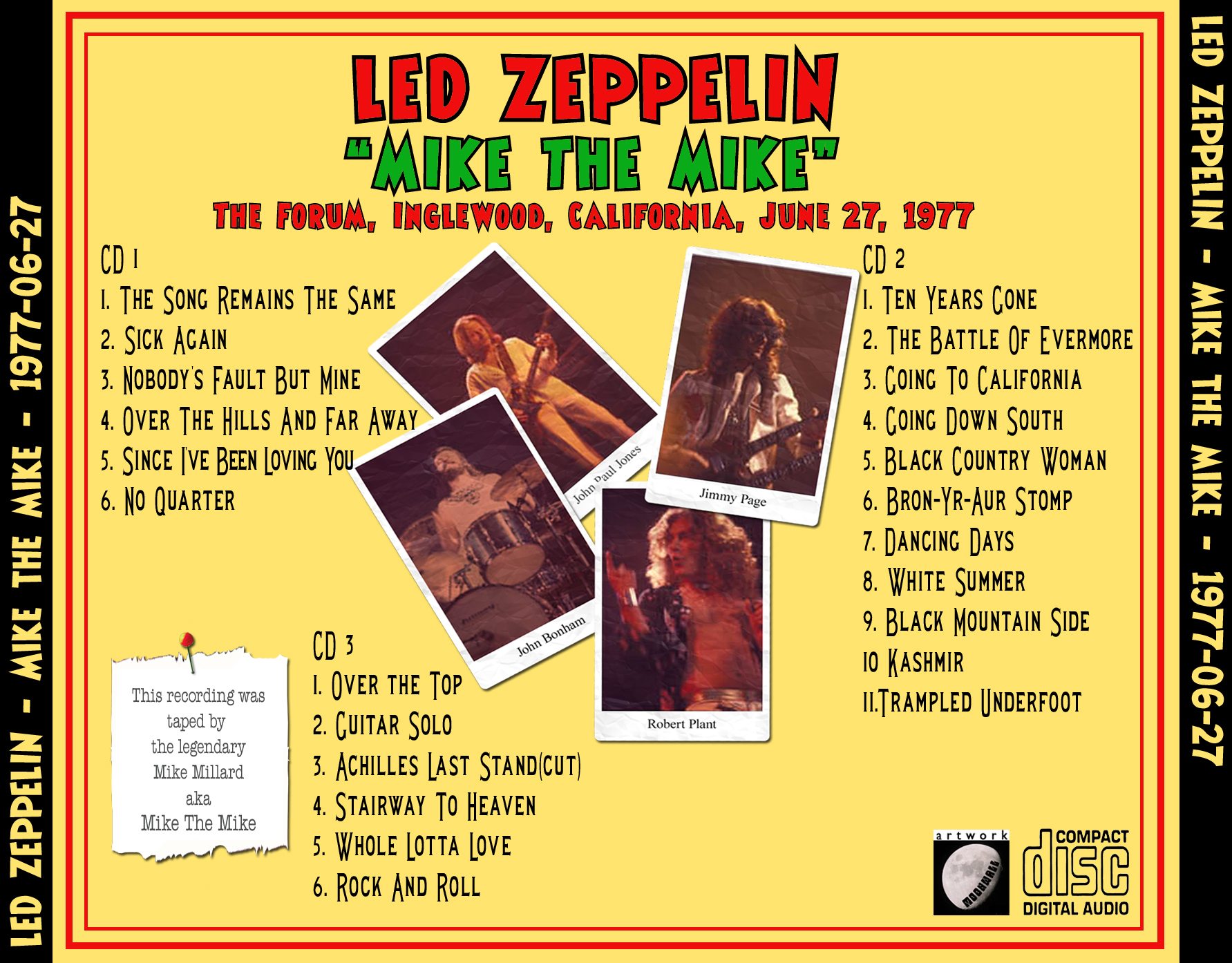
Led Zeppelin - 1977-06-27 Mike the Mike Inglewood US 1977 (3CD) (Bootleg)


Size: 509 MB
Bit Rate: 320
mp3
Recorded by: Mike Millard
Artwork Included

Mike Millard (May 18, 1951 – November 29, 1994), nicknamed "Mike The Mic" was an avid concert taper circa 1973 to 1994, recording over 300 concerts, including Led Zeppelin, Pink Floyd and The Rolling Stones concerts in California. He taped virtually every show at the Forum from 1974 to 1980. Many of his recordings found their way into the hands of bootleggers who sold Millard's work to fans.

Starting with a basic mono recorder in 1973, Millard upgraded to a Nakamichi 550 stereo recorder with AKG Acoustics 451E microphones for the 1975 Led Zeppelin shows in the area. He often used a wheelchair to conceal his equipment, pretending to be disabled. Unlike most 1970s audience bootlegs, Millard's recordings are known for their good sound quality, and are to this day considered some of the finest audio bootlegs available.


Millard's recording of the Led Zeppelin concert on June 21, 1977 at the Forum (allegedly taped from row number six) was released under the title Listen To This Eddie, and remains one of the best-known Led Zeppelin bootlegs. His recording of the opening number from the concert, "The Song Remains The Same", was included in the promos menu of the Led Zeppelin DVD. Millard recorded four of the Rolling Stones five 1975 shows at the LA Forum, and his recording of the Sunday, July 13, 1975 show (titled 'LA Friday') has become one of the most widely spread recordings of a Rolling Stones concert.


Millard was never behind the sale of bootlegs and was openly against the illegal sale of his recordings. He was notorious for "marking" copies of his tapes so that if one of his recordings turned up for sale on LP or CD, he would be able to tell which person he had traded it to. He kept a very detailed logbook of his marked recordings and who they were distributed to. "Unmarked" copies of Millard's recordings are very scarce. In 2016 several unmarked first generation copies of his Led Zeppelin recordings surfaced in trading circles.

Millard is said to have suffered from severe depression. He committed suicide in 1994.

The Millard recording set-up was used by The National in 2019 to record two of their shows in Berkeley, CA, and an accompanying documentary titled Juicy Sonic Magic: The Mike Millard Method was also created.


Mike is most known for the 10 Led Zeppelin shows that he recorded in southern California in the 1970s. Those shows include March 11th and 12th in Long Beach and at the Forum on March 24th, 25th, and 27th on the North American tour. When the band returned to southern California for the concert tour of North America, he recorded the band in San Diego June 19th and then four times at the Forum on June 21st, 23rd, 25th, and 27th.

A 2021 Rolling Stone article  lauded the quality of his April 26, 1975 recording of Pink Floyd, going so far as to say, "If Pink Floyd ever decides to create a Bootleg Series, they should get their hands on Millard’s master tapes — starting with this 1975 Los Angeles gig. It’s the band at the peak of their abilities as a live act and deserves to be heard as widely as possible."

Juicy Sonic Magic: The Mike Millard Method, a 10-minute mini-documentary directed by David DuBois.


The film tells the story of late, great concert taper Mike “The Mike” Millard and an homage to his work that was undertaken by archivist and producer Erik Flannigan, who attempted to recreate the legendary taper’s methods by using the same vintage cassette deck and microphones Millard employed in the ’70s to record our two Greek Theatre concerts last year.

Millard became a legend for his high-quality bootleg recordings of artists like Led Zeppelin, Pink Floyd, Bob Dylan and many others made in and around Southern California in the ’70s and ’80’s by sneaking his equipment into concerts hidden in a wheelchair. The film features animation by illustrator Jess Rotter and Eben McCue, plus interviews with Matt Berninger, producer/archivist Erik Flannigan and Mike Millard’s friend Jim Reinstein, who pushed Millard and his wheelchair into dozens of shows.

Flannigan explained the idea behind using The Mike Millard Method in the liner notes of the accompanying Black Friday Record Store Day three-cassette box set release (out November 29 via 4AD) entitled 'The National: Juicy Sonic Magic, Live in Berkeley, September 24-25, 2018', saying:

“The most celebrated audience taper of the period, Mike Millard, recorded in and around Southern California beginning in 1974 and continued into the early ’90s. Millard’s legend is built in part on the cunning and subterfuge he used to get his nearly 15-pound cassette deck and microphones into venues like the The Forum, Santa Monica Civic Auditorium, and The Roxy. 

For years I have pondered what made Millard’s recordings so good, and eventually I had an idea: What if you recorded a concert today with the same equipment Millard used in 1977? Would it sound like his tapes? Would it tap into his Midas touch?

The National was kind enough to let us test the Millard Method for two concerts at the Greek Theatre in Berkeley, California last September. These live recordings were made with vintage AKG 451E microphones and a restored Nakamichi 550 cassette deck which are identical to those used by Millard circa 1975-81. The idea was to see if we could recreate what Matt Berninger calls the “juicy sonic magic” Millard captured in his 1970s field recordings.

Together with my friend and filmmaker David DuBois, we also produced a short documentary about Millard, his recording methods, and our attempt to recreate his work at the National shows in Berkeley, a venue that is utterly unchanged since the ’70s. 

With the advent of smartphones, thousands of people routinely record part of the show when they attend a National concert or any other performance. Forty years ago, when nobody would dare do that, one man made it his life’s work to preserve legendary concerts on tape.”

Led Zeppelin
The Forum, Inglewood, California
June 27, 1977
Taper: Mike Millard
Title: "Mike the Mike"
 
CD 1
01. The Song Remains The Same  
02. Sick Again
03. Nobody's Fault But Mine  
04. Over The Hills And Far Away
05. Since I've Been Loving You  
06. No Quarter  

CD 2
01. Ten Years Gone
02. The Battle Of Evermore  
03. Going To California
04. Going Down South
05. Black Country Woman  
06. Bron-Yr-Aur Stomp 
07. Dancing Days 
08. White Summer
09. Black Mountain Side  
10 Kashmir
11.Trampled Underfoot 

CD 3
01. Over the Top  
02. Guitar Solo
03. Achilles Last Stand(cut)
04. Stairway To Heaven  
05. Whole Lotta Love
06. Rock And Roll 

Part 1: Mike The Mike
Part 2: Mike The Mike
Part 3: Mike The Mike
or
Part 1: Mike The Mike
Part 2: Mike The Mike
Part 3: Mike The Mike
or
Part 1: Mike The Mike
Part 2: Mike The Mike
Part 3: Mike The Mike

Wednesday, June 22, 2022

Thunderduk - Selftitled (Good Hardrock US 1974)


Size: 71.3 MB
Bit rate: 256
mp3
Ripped By: ChrisGoesRock
Artwork Included

A highly uncommercial Cleveland, Ohio rock group. Their recordings are rather hit and miss affairs. All nine cuts on the Rockadelic album are originals. The finer moments include the driving guitar on opener Why Don't You Love Me?, the fine jamming guitar work on Time And Again and, by contrast, the mellow slow-paced Something To Look At with its dominant percussion work. 

The recordings on the Rockadelic album span the 1972 - 74 period when their desire to play original music and their on stage antics made them one of the top draws on the Cleveland Club scene. Bob Turchek was later replaced on drums by ex-Catscradle drummer Rick Fischer. Most of the material on the Rockadelic album was played by the band on two Agency Studio live broadcasts carried by local station WNCR.


Band photos and raw opening track may tempt one to file this among the typical Rockadelic teenage basement hardrock blowouts, but in actuality this is a local prog/jazzrock affair that's a bit left field both for the label and my hi-fi. The uptempo, energetic excursions suffer from so-so songwriting and a dry, clinical soundscape that cries out for keyboards, fuzz and feedback, and jars with the distorted vocals. Liner notes claim they were a big draw live but it doesn't really sound like it, and there's an odd atonal and out of synch feel to the recording as a whole -- but maybe that's right for the genre. Couple of OK tracks, but too little guitar, and neither psych, folk nor hardrock; may appeal to fans of the UK hard prog scene. 1972-1974 recordings.

01 - Why Don´t You Love Me
02 - Mountain By The Moon
03 - Something to Look At
04 - Time And Again
05 - The Collector
06 - Keep On Comin´
07 - Number One
08 - Once Again Darkness
09 - Jake 26 

or
or

Howling Black Soul - Selftitled (Old School Hardrock UK 2014) Sounds like a band from the early 70's


Size: 81.6 MB
Bit rate: 320
mp3
Ripped by: ChrisGoesRock
Some Artwork Included

"Howling Black Soul are a powerhouse trio like they used to do. Free meets Black Sabbath with a 1972 valve amp thrown in for good measure.....turn this up loud." The band - described as "Free meets Black Sabbath with a 1972 valve amp thrown in for good measure" - have a sound steeped in blues with a retro groove of the late 1960s and early 1970s.


Support will come from teen brothers Ben and Toby Jordan who go by the name Bavard, described as "the youngest song-slingers in town" by their hosts, Howling Black Soul.

Bavard will be playing an electric set, helped by 13-year-old Herbie Buckley-Robinson on full drum kit. On this weeks show I was joined by Essex band `Howling Black Soul` the 3 peice, consisting of Dario on vocals and lead guitar, Simon W on Bass, and Simon C on Drums.


We established that the their music genre was  `Blues Rock`.  this is the band description in their own words;

“Howling Black Soul” Initially sprang from a shared obsession for bands such as `Led Zepplin, `Free`,`Cream, `Jimi Hendrix, and other late 6o`s/early 70`s dirt and the dark art of blues specialists!! Their sound is steeped in blues; however, they have developed a modern spin on the classic genre and build on contemporary influences such as; kasabian`White Strpes`, `The Black keys` ect to create a unique Rock experience…………..

01. Soul to lay 03:24
02. Full of Desire 03:54
03. Myself 03:16
04. Darlin' You 04:45
05. See the Light 03:13
06. Shoot You Down 04:02
07. Brand New Soul 03:26
08. Another Dawn 02:52
09. Roll Out Your Head 04:19

or
or


Thursday, June 02, 2022

Grateful Dead - Selftitled (1st Classic Album US 1967 and a Lot of Bonus Tracks)


Size: 366 MB
Bitrate: 320
mp3
Ripped by: ChrisGoesRock
Artwork Included
Source: Japan SHM-CD Remaster

The Grateful Dead is the debut album of the Grateful Dead. It was recorded by Warner Bros. Records, and was released in March 1967. According to bassist Phil Lesh in his autobiography Searching for the Sound: My Life with the Grateful Dead, the album was released as San Francisco's Grateful Dead.


The album was recorded primarily at Studio A in Los Angeles in only four days. The band had wanted to record the album in their hometown of San Francisco, but no good recording studios existed in the area at the time. The group picked David Hassinger to produce because he had worked as an engineer on the Rolling Stones' "(I Can't Get No) Satisfaction" and Jefferson Airplane's Surrealistic Pillow album (on the latter of which Jerry Garcia had guested as well having suggested the album's title). Demands by Warner Bros. resulted in four of the tracks, originally longer, being cut short. Phil Lesh comments in his autobiography that "to my ear, the only track that sounds at all like we did at the time is Viola Lee Blues. ... None of us had any experience with performing for recording ... although the whole process felt a bit rushed."

The album was seen as "a big deal in San Francisco." Even though this was true, it did not see much air play on AM radio stations outside San Francisco. It would be a couple of months before free-form FM radio stations began to take shape.[4] Warner Bros. threw the band a release party at the Fugazi Hall in North Beach. Joe Smith is noted for saying he is "proud that Warner Bros. is introducing the Grateful Dead to the world."

A remastered version with the full versions of five album tracks, plus six bonus tracks, was released by Rhino in as part of the box set The Golden Road (1965-1973) in 2001, and as a separate album in 2003.
The song "Alice D. Millionaire" was inspired by an autumn 1966 newspaper headline "LSD Millionaire", about the Dead's benefactor and sound engineer Owsley Stanley.

In the original design for the album cover, the cryptic writing at the top read, "In the land of the dark, the ship of the sun is driven by the Grateful Dead", with the phrase "Grateful Dead" in large letters. At the band's request, the writing, except for "Grateful Dead", was changed by artist Stanley Mouse to be unreadable. According to fan legend, the saying is from Egyptian Book of the Dead.


The band used the collected pseudonym McGannahan Skjellyfetti for their group-written originals and arrangements. The name derived from a corruption of a character name in the Kenneth Patchen work The Memoirs of a Shy Pornographer.

The entire LP was remixed in the early 1970s by the Grateful Dead themselves—the original mix is found on LPs bearing the Gold (1967 stereo/mono) Warner Brothers label or W7/WB dark green Warner Brothers label (1968-1971). The remix (palm trees Burbank label) differs significantly from the original 1967 release.


The album was reissued for Record Store Day 2011 on 180g vinyl cut from the original analog/mono masters from 1967. This is the first time in 40+ years it has been released in this form.

The 2013 high definition digital remastered release features the edited versions, as released in 1967, of the four tracks which were extended in the 2003 Rhino release.

Open Picture in a new window

The Grateful Dead's eponymously titled debut long-player was issued in mid-March of 1967. This gave rise to one immediate impediment -- the difficulty in attempting to encapsulate/recreate the Dead's often improvised musical magic onto a single LP. Unfortunately, the sterile environs of the recording studio disregards the subtle and often not-so-subtle ebbs and zeniths that are so evident within a live experience. So, while this studio recording ultimately fails in accurately exhibiting The Grateful Dead's tremendous range, it's a valiant attempt to corral the group's hydra-headed psychedelic jug-band music on vinyl. Under the technical direction of Dave Hassinger -- who had produced the Rolling Stones as well as the Jefferson Airplane -- the Dead recorded the album in Los Angeles during a Ritalin-fuelled "long weekend" in early 1967. 

Rather than prepare all new material for the recording sessions, a vast majority of the disc is comprised of titles that the band had worked into their concurrent performance repertoire. This accounts for the unusually high ratio (seven:two) of folk and blues standards to original compositions. The entire group took credit for the slightly saccharine "Golden Road (To Unlimited Devotion)," while Jerry Garcia (guitar/vocals) is credited for the noir garage-flavored raver "Cream Puff War." Interestingly, both tracks were featured as the respective A- and B-sides of the only 45 rpm single derived from this album. The curious aggregate of cover tunes featured on the Dead's initial outing also demonstrates the band's wide-ranging musical roots and influences. 

These include Pigpen's greasy harp-fuelled take on Sonny Boy Williamson's "Good Morning Little School Girl" and the minstrel one-man-band folk of Jessie "the Lone Cat" Fuller's "Beat It On Down the Line." The apocalyptic Cold War folk anthem "Morning Dew" (aka "[Walk Me Out in The] Morning Dew") is likewise given a full-bodied electric workout as is the obscure jug-band stomper "Viola Lee Blues." 

Fittingly, the Dead would continue to play well over half of these tracks in concert for the next 27 years. [Due to the time limitations inherent within the medium, the original release included severely edited performances of "Good Morning Little School Girl," "Sitting on Top of the World," "Cream Puff War," "Morning Dew," and "New, New Minglewood Blues." These tracks were restored in 2001, when the Dead's Warner Brothers catalog was reassessed for the Golden Road (1965-1973) box set.] [Wikipedia + AMG]
 
Personnel
♫♪♪♫♪ Jerry Garcia – lead guitar, vocals, arrangement
♫♪♪♫♪ Bill Kreutzmann – drums
♫♪♪♫♪ Phil Lesh – bass guitar, vocals
♫♪♪♫♪ Ron "Pigpen" McKernan – keyboards, harmonica, vocals
♫♪♪♫♪ Bob Weir – guitar, vocals

01. "The Golden Road (To Unlimited Devotion)" (Grateful Dead) – 02:12
02. "Beat It on Down the Line" (Jesse Fuller) – 2:33
03. "Good Morning Little School Girl" (Sonny Boy Williamson) – 05:50
04. "Cold Rain and Snow" (Obray Ramsey) – 02:31
05. "Sitting on Top of the World" (Lonnie Chatmon and Walter Vinson) – 02:08
06. "Cream Puff War" (Jerry Garcia) – 02:31
07. "Morning Dew" (Bonnie Dobson and Tim Rose) – 05:09
08. "New, New Minglewood Blues" (Noah Lewis) – 02:37
09. "Viola Lee Blues" (Lewis) – 10:17

Bonus tracks: Live July 29, 1966
10. Standing on the Corner (Live at P.N.E. Garden Auditorium)  03:22
11. I Know You Rider (Live at P.N.E. Garden Auditorium)  03:14
12. Next Time You See Me (Live at P.N.E. Garden Auditorium)  03:36
13. Sittin' on Top of the World (Live at P.N.E. Garden Auditorium) 03:46
14. You Don't Have to Ask (Live at P.N.E. Garden Auditorium)  05:14
15. Big Boss Man (Live at P.N.E. Garden Auditorium)  04:15
16. Stealin' (Live at P.N.E. Garden Auditorium)  03.37
17. Cardboard Cowboy (Live at P.N.E. Garden Auditorium)  02:56
18. It's All over Now, Baby Blue (Live at P.N.E. Garden Auditorium)  05:22
19. Cream Puff War (Live at P.N.E. Garden Auditorium)  07:52
20. Viola Lee Blues (Live at P.N.E. Garden Auditorium) 10:02
21. Beat It on down the Line (Live at P.N.E. Garden Auditorium)  02:46
22. Good Mornin' Little Schoolgirl (Live at P.N.E. Garden Auditorium)  05:47

July 30, 1966
23. Cold Rain and Snow (Live at P.N.E. Garden Auditorium)  03:14
24. One Kind Favor (Live at P.N.E. Garden Auditorium)  04:23
25. Hey Little One (Live at P.N.E. Garden Auditorium)  05:39
26. New, New Minglewood Blues (Live at P.N.E. Garden Auditorium)  03:22

Extra Bonus
27. "Alice D. Millionaire" (Grateful Dead) – 2:22
28. "Overseas Stomp (The Lindy)" (Jab Jones and Will Shade) – 2:24
29. "Tastebud" (Ron McKernan) – 4:18
30. "Death Don't Have No Mercy" (Reverend Gary Davis) – 5:20
31. "Viola Lee Blues" (edited version) (Lewis) – 3:00
32. "Viola Lee Blues" (live at Dance Hall, Rio Nido, CA 9/3/67) (Lewis) – 23:13

• The Japan CD reissue contains the full-length versions of "Good Morning Little Schoolgirl", "Sitting on Top of the World", "Cream Puff War", "Morning Dew", and "New, New Minglewood Blues"

• Tracks 27-30 recorded at RCA Victor Studio A, Hollywood, CA on February 2, 1967
• Track 31 is an edited version of track 09.
• Track 32 recorded live at Dance Hall, Rio Nido, CA on September 3, 1967; the master analog reels of "Viola Lee Blues" are said to exclude the beginning of the song.

Part 1: Grateful
Part 2: Grateful
or
Part 1: Grateful
Part 2: Grateful
or
Part 1: Grateful
Part 2: Grateful